Cash Registers and the Man Divinely Appointed to Build Them (1/2)
Download MP3Recording 2 - Jun 20, 6:04 AM
===
Theme music
---
[00:00:00]
Intro
---
Dan Slimmon: Cha-ching, cha-ching, listeners, and welcome to Technology Blows, the techno-pessimist podcast I am here today with my great friend, Daniel Ryan, who, I have known for what? Maybe 15 years. Um, we've worked...
Daniel Ryan: been that long?
Dan Slimmon: I think so. I think so.
Daniel Ryan: The linear nature of time is upsetting
Dan Slimmon: yeah. Oh, who, who, boy.
So, um, I've known Daniel for [00:01:00] 15 linear years. We've worked together. We've, um, slacked off work together. It's been a fantastic, it's been a fantastic time, and I'm so, I'm so glad. So welcome to the show, Daniel Ryan.
Daniel Ryan: Thanks, Dan. I am stoked to be here. Yeah, we've, we've complained a lot about technology together
Dan Slimmon: Oh my God.
Daniel Ryan: like. It
Dan Slimmon: Oh,
Daniel Ryan: to be bad
Dan Slimmon: you're one of the main-- I would say you're one of the main things in my life that got my brain in this, stuck in this loop that I, that forced me to start a podcast. Mm-hmm.
Daniel Ryan: Oh,
Dan Slimmon: I was like, "Wait a second, technology is not so great, is it?" Um, so thank you for that.
Daniel Ryan: It is not
Dan Slimmon: Um, I, uh, I just got back from...
We-- As listeners will know, we've been off for a few weeks in a row. I just got back from a vacation in Scotland where, um, where I had a fantastic time, and the sun was setting at [00:02:00] 11:30 PM and rising at 1:30 AM, which rules
Daniel Ryan: Yeah. Yeah, that sounds about right. Uh-oh. We've got 3:53 AM sunrise here and 10:49 PM sunset, if you can call it setting
Dan Slimmon: Yeah. It just sort of, what is it? Just sort of like skim along the horizon for a bit
Daniel Ryan: Yeah. I mean, I'm not above the Arctic Circle, but it's, it's effective- it doesn't get truly dark
Dan Slimmon: Yeah. Fantastic. Fantastic. That's gotta be great for your brain and your hormones and your body and all that stuff
Daniel Ryan: It's so fun. I love summer
Dan Slimmon: Uh, I got to, I'm sure you know this is not special to you, but I got to feed, um, a reindeer with my hands.
Daniel Ryan: That's pretty awesome
Dan Slimmon: Okay, good. I'm glad you think that's awesome. Yeah. Um, they got, they have re- reindeer in Scotland.
Who knew?
Daniel Ryan: Nice
Dan Slimmon: Yeah, it, it was great. Uh, what else did we do? We rode a, we rode a funicular, um, up to a mountain and, [00:03:00] uh, looked down at a bunch of lochs. We went to a castle on a
Daniel Ryan: They've,
Dan Slimmon: loch.
Daniel Ryan: got a lot of those
Dan Slimmon: Yeah. They almost didn't let me into the country because I was traveling with, um, my daughter who has a different surname than I do, and they were like, "Are you sure you are, are not abducting her?
Do you have her birth certificate?"
Daniel Ryan: Wow.
Dan Slimmon: Um, which was,
Daniel Ryan: copy or something? 'Cause I
Dan Slimmon: I didn't know
Daniel Ryan: a copy of my birth certificate. Like, why
Dan Slimmon: Of course I didn't. Uh, why would I have a copy of her birth certificate? That's crazy. And the lady was like, "You know, I do this, I would do this even if you were a mom and traveling with a daughter with a different name." And I was like, "Sure, but, like, why though?"
Uh, yeah, I don't know. Bureaucracy. We made it and it was a fantastic trip. We, we took a haunted, haunted tour in Edinburgh [00:04:00] under the, under the streets of Edinburgh in the, the, um, vaults where people used to live and die, and,
Daniel Ryan: I think
Dan Slimmon: it was fantastic.
Daniel Ryan: that when I was there.
Dan Slimmon: Oh, yeah.
Daniel Ryan: Yeah,
Dan Slimmon: Spooky
Daniel Ryan: years ago. It was spooky. I
Dan Slimmon: Yeah. Love a spooky tour. Um, see, even, you know, I d- you wouldn't think a six-year-old girl would love a spooky tour, but she has not stopped talking about it.
She thought it was fantastic. Um,
Retail jobs
---
Dan Slimmon: you ever worked retail?
Daniel Ryan: I have. I, uh, when I was, like, 16, I worked selling hardware at Sears, which an introverted person, and we got trained very, very, very heavily to not take no for an answer. Like, you go talk to those people, and you follow them around the store, and you make sure that they y- they don't have any questions.
And then when they get to the cash register, you gotta upsell them on [00:05:00] everything, and, like, every introverted bone in my body hated doing that. I was not good at that job
Dan Slimmon: That's laudable. I think, I think people should not be good at that job
Daniel Ryan: Yeah, I just, when I'm shopping, I wanna be left alone, and I tried to leave people alone, and my bosses did not care for that strategy
Dan Slimmon: Yeah. Yeah, it's like, "Hey man, do you want a, do you want a screwdriver? No?
Daniel Ryan: No?
Dan Slimmon: I guess you don't, I guess you don't need a screwdriver then." Um, yeah, that's the way the world should be. But no, I, I'm not a, uh, re- retail's not my jam either. I worked one summer, uh, during high school part-time as a janitor/cashier at a little chocolate shop in Jacksonville, Florida,
Daniel Ryan: Ooh
Dan Slimmon: a, in a strip mall.
Uh, that was a wild time. My-- I had my, uh, my boss, Teresa, who owned the chocolate shop, was this chain-smoking, chain Diet Coke-drinking [00:06:00] evangelical Christian who was just constantly trying to convert me to go to her Baptist ch- church. She had sold her trucking company, uh, prior, two, two years prior to starting the chocolate shop because Jesus told her she needed to start a chocolate shop
Daniel Ryan: I mean, if it involves chocolate, who am I to argue with Jesus?
Dan Slimmon: Yeah. Yeah. Two of j- people's favorite things Uh, and, and she, I don't-- I never saw her, like, actual eating the chocolate. She mostly just drank three cases of Diet Coke and smoked three packs of, packs of cigarettes every day.
Daniel Ryan: As one does
Dan Slimmon: but you know, if G- yeah, exactly. If God, uh, as, if God tells you you need to start a chocolate shop, you you put your life on pause for a year, and you start a chocolate shop.
Um, which, which I kind of, I kind of admire the, the, the, the, you know, the, um, way she buckled down and [00:07:00] did that.
Daniel Ryan: There are worse things that Jesus could have told her to do with her time
Dan Slimmon: Yeah, I can think of some. I can think of some. Uh, but it is kind of, it's not dissimilar from God telling somebody they need to become a serial killer, right? It's like, it's the same sh- it's structurally the same, but inst- but, but just, like, happens to be a different message. But God can say whatever he wants, you know?
Daniel Ryan: That's true. Nobody can stop him
John Patterson wants to be your sledgehammer
---
Dan Slimmon: Well, the, yeah, uh, the, the main character of these episodes, John Henry Patterson, never talked to God or never, never wrote down or recorded that he talked to God. But according to his biographer, he thought himself divinely appointed to make cash registers
Daniel Ryan: That's all right. Good for him, I guess
Dan Slimmon: It's, it's a, it's kind of a sad thing to be divinely appointed to, but, you know, everybody's [00:08:00] got, everybody's got a job to do. He ran a, a beautiful, a truly beautiful factory that other business leaders of the late 1800s would often visit to see how, how, how he did this amazing thing. And to show you what it looks like when a man thinks himself divinely appointed to make cash registers.
Once, toward the end of a tour, Patterson showed, was showing his guests into a room full of these shiny new finished cash register units, uh, and, and he announced, "These registers are in perfect working order and all ready for shipment." And then to demonstrate, he, he went to one of the machines and he, he rang up a sale on the machine.
But it, it didn't work right. He-- It had a defective key on one of the machine. One of the keys was defective on the machine. So he's trying to show these people, and it's not working. so his expression turns dark and he mutters, "I will show you what we do with registers that don't work." And he [00:09:00] grabbed a nearby mallet, hefted it over his head, and just smashed this defective machine to tiny bits in the, in front of the tour group
Daniel Ryan: I mean, to be fair, who among us when smited by the demo gods like that has not wanted to take a hammer to whatever device decided to smite us? Like, that is a fair and proportional reaction if you ask me
Dan Slimmon: That's true. The, the sales, the way that sales, sa- technical salespeople manage to not smash the, the monitor that they're showing the, or the projector that they're showing the, my tech to when my tech falls over because I'm at lunch and I forgot to g- click retry on the deploy script. It's ... I, I don't know how they do it.
Incredible forbearance. Um, so he, I guess he invented that. He invented the, the failed tech demo in the way that he invented so many other things that we're gonna talk about that, uh, are [00:10:00] still with us, unfortunately, today in the, uh, technical, in the, in the service and industrial industries. So so John Henry Patterson w- wasn't just a, a boss with a bad temper smashing this, this machine with the mallet. He was a man who was terrified and disgusted by imperfection, whether it be in a product or in a worker or in his own body. And he believed that perfection could and must be achieved through a synthesis of technology and the body.
So in these episodes, we're gonna watch that attitude inform everything this man does, from the training of his sales force to the cash register itself, to the temperature and number of his multiple daily baths, and I hope you're ex- as excited about this as I am. Daniel Ryan.
Daniel Ryan: that sounds like quite a guy
Dan Slimmon: Yeah. Uh, [00:11:00] he was, if nothing, if nothing else, quite a guy.
Uh, but we're not gonna talk about him. Before we get to... We're not gonna talk about him quite yet. Uh, before we get to John Henry Patterson, uh, it- as everyone knows, if you want to batter a cash register to smithereens, you must first invent the cash register.
James Rittty's Incorruptible Cashier
---
Dan Slimmon: So first, we're gonna talk to, t-talk about, uh, James Jacob Ritty.
James Ritty is the proprietor of the Empire House Saloon in Dayton, Ohio. And in about 1878, he realizes he has a problem. He's been keeping track of how much liquor is being poured from his liquor bottles, and he's probably like, I don't know exactly what he was doing, but he's probably notching the labels as bar owners still do today, where they'll, like, notch where the liq- where the line is, uh, one night, and at the end of the night, they'll see how much liquor was poured out, and they'll compare it to the receipts to see if [00:12:00] anybody's stealing from them.
And Ritty realizes people are stealing, people are stealing liquor from his shelves. It's probably his employees. The idea that his employees are stealing profits drives James Ritty completely batshit. He starts obsessively watching the till. He can't sleep. He's thinking about it all the time. Eventually, he finds himself on the verge of a nervous breakdown, so he decides to just...
He needs to... It's probably his doctor tells him he needs to go on a vacation to Europe to take his mind off the, off the, um, the cash problem. Get some, get some fresh air on a ship. And yeah.
Daniel Ryan: Yeah
Dan Slimmon: Yeah, get some s- that's what they prescribed for fucking everything in the late 1800s 'cause they didn't have medicine yet.
It was just, uh, you know, "Oh, you, you, you broke your, you broke your leg? Well, it sounds, sounds like you need to take a walk around a ship's deck for a few weeks."
Daniel Ryan: Or leeches. I feel like leeches
Dan Slimmon: [00:13:00] Yeah.
Daniel Ryan: popular back then
Dan Slimmon: Yeah, take a, take a boat tour of some South American swamps and just go, go swimming
Daniel Ryan: What could go wrong?
Dan Slimmon: Um, so on the ship, he's on this ship, he is relaxing, and one of the ways he wants to relax is he goes-- he asks if he can visit the engine room like a, like a, a child on an airplane. Which, hell yeah. Like, I would love to visit an 1800 steamboat engine room.
I would drive that captain out of his mind. I would ask, be asking about every doohickey and thingamabob in the room. You know, uh, I, I, I get it. I get what, what he, what he wants out of this.
Daniel Ryan: Yeah
Dan Slimmon: Uh, um, what he fatefully sees in this engine room is a gauge that registers the number of revolutions of the ship's propeller.
Uh, so it just counts how many revolutions the propeller is, is doing. I don't know exactly what device this [00:14:00] is. Probably something that we call a, a Veeder counter, which, which is just like a, a early industrial device that, that can count how often it gets twisted around. Uh, Ritty gets home and this rotation counting machine i-is living rent-free in his head.
He's like, "Well, what if we could have that, but for how much liquor is being poured out of the bottles in my shop?"
Uh, and, and... Right? Uh, so I don't know. It's like, come on, man. You visit this... It's a tech- it's like a cave of wonders is, is this bridge of a modern steamship. The, uh, all this amazing technology, and that's your takeaway?
He's like, it's so lame to me. Um, but that's the kind of guy he is, you know? He's the kind of guy who could, who could walk through the engineering bay of the USS Enterprise and completely ignore the [00:15:00] warp core and instead he'd be like, "What is this incredible man-sized tube? Why, I could, I could use these in my saloon to catch thieving employees red-handed."
Right?
Daniel Ryan: And I bet he didn't even go home and, like, decorate the inside of his saloon like a steamship engine room
Dan Slimmon: Oh my God. If you, if you've got a problem with profits, go, go theme saloon, right? Now you're a tourist attraction.
Daniel Ryan: Right?
Dan Slimmon: Think outside the box, man. No, he's a very much inside the box thinker, and so he decides to build a box. He goes to his brother, uh, who's, who's a mechanic, and he says, "Would it be possible to build a counting machine?
But instead of registering p- propeller rotations, it registers cash."
Daniel Ryan: Hmm
Dan Slimmon: So together they come up with this truly ingenious invention and, and truly in, in a way [00:16:00] I would say beautiful invention that they call the incorruptible cashier
Daniel Ryan: Oh, incorruptible. I like that
Dan Slimmon: Yeah. He, he had a little bit of a flair for, um, for some things, but he was terrible at other things in business. Um, but, but I, you know, I kind of, I kind of like this incorruptible cashier name, and it, and it carries a little bit of meaning that cash register doesn't carry anymore. Um, but we'll, we'll get to, we'll get to what the cash register actually is with respect to employees.
But go- going, going off patent, um,
How the first cash register worked
---
Dan Slimmon: so I'm gonna tell you about how the cash register works. The first, first cash register, um, he filed, I'm going off of, uh, patent 271363, filed in January of 1883 by James Ritty and another, an, an engineer that he hired. I think it's an engineer. Um, so it, it [00:17:00] has a row of keys in intervals of five.
They're labeled five, 10, 15, 20, um, in, on the front panel, and that indicates the number of cents in the purchase. Uh, so they're in increments of five, so I guess pennies were already irrelevant by 1883, um, and yet it still took us another fucking 140 years or whatever to actually get rid of them. Uh, so you press, so for example, you press the five key.
Inside the machine, that turns the five-cent wheel and pops up, uh, it also pops up a, a tablet labeled five in behind glass in the top panel so that the, the customer can see how much they're being charged. the five-cent wheel that it, that is turned when you press the key has 20 segments. They're labeled, they're, they're with like little engraved numbers on them, five, 10, 15, 20.
and, and then the 10-cent wheel has 20 segments labeled 10, 20, 30, 40, and, and so [00:18:00] on up to $2. right? Uh, so each of... And, and these wheels are all sort of, um, geared together so that when, when one of them turns all the way around, it increments the next wheel by the appropriate, uh, amount, so that over the course of the day as you press these buttons, these dials inside the machine are just counting up the total amount of cash, the total amount of money that has changed hands.
so each key has, at, at the s-- so at the start of the day, the way it works and the way it works for the proprietor of the, of the establishment is start of the day, you open... the proprietor opens the machine and goes in with his finger and sets all the wheels to zero.
And then at the end of the day, he opens up the machine again, and he jots down the reading on paper. All the readings, he has to, has to write down all the readings on paper and add them up, and then he can, uh, see how much cash is in the till [00:19:00] and compare that to how much was, uh, there at the beginning of the day.
And if the numbers don't match, then,
Daniel Ryan: He goes and yells at someone
Dan Slimmon: he goes and yells at somebody. Who? I don't know. Uh, you know, but, but that's, that's the theory at least, is that he can at, at least help him figure out who's, who's stealing from him. Um, right. So the operator can't see the dials inside the machine. So if he thinks he has some trick to, like, get to make the cash register ring up the wrong amount so he can steal some money, he can't see the dial, so he can't tell if his trick is working,
Daniel Ryan: Mm.
Dan Slimmon: right?
Uh, and later designs are gonna improve on the convenience of this, but it says something about Ritty, how deeply paranoia is designed into every aspect of this machine. Like, it has to have a lockable metal [00:20:00] case with a key that only he has. The operator can't see the dials. The-- there's a bell that chimes with every key press, which functions, as the patent explains, to give notice to the customer that the machine has been properly operated.
But it's also so Ritty can be like, "Oh, what's that? Did somebody open the cash drawer? What are you doing over there?" Um, it's got these indicators behind glass and, and it's even, the paranoia is even encoded into the name, the Incorruptible Cashier, right?
Daniel Ryan: I'm hearing is that this guy was like the first security engineer
Dan Slimmon: Yeah. Yeah. If, if the com- if the security engineer was also the, the CEO
Daniel Ryan: Yeah. I'm sure that's happened once
Dan Slimmon: yeah, exactly. He's, he's like, he's just thinking about all the angles or how, how could these-- how, how, how could anybody possibly
Daniel Ryan: wrong? Yeah
Dan Slimmon: a little bit of money from me? Um, and, and this,
What the cash register really was
---
Dan Slimmon: I [00:21:00] think this paranoia tells us an enormous amount about what cash registers actually are.
Uh, we don't think about them really in the modern day, but, but the project of the cash register is not just to build a useful accounting tool, right? From the v- from this very first patent, the project is to integrate the employee's body with machinery and thereby sort of constrain these slippery human abilities like speech and thought by replacing, placing what humans can do with like trunnions and detents and spring-loaded ratchets, uh, so that, so that the cash register and the cashier sort of form a, a system together that channels profit around the cashier's soul and into the owner's bank account.
That's the way I, that's the way I look at it. Um, and Ritty's doing fine, right? He owns multiple saloons. [00:22:00] He's going on European vacations to calm his nerves. But, but given the choice between spending years of his life developing this patent and then devoting four square feet of counter space forever to this enormous clanging hunk of steel versus just paying his employees a profit share and chilling the fuck out, he goes with the hunk of steel
Daniel Ryan: I mean, that, that sounds like a capitalist. Like, you don't become the rich dude who can go on steamships by being fair to your employees. Don't be ridiculous
Dan Slimmon: That's right. All the profit has to funnel up.
Daniel Ryan: Yeah
Dan Slimmon: Um, if it's not, if the profit's not funneling up, why even have a bar? It's not like people like drinking alcohol
John Patterson's early life
---
Dan Slimmon: now Ritty, like I said, he's not the best at, at business per se. Uh, r- he tries to make the leap from selling whiskey to selling the Incorruptible Cashier, uh, as an industrialist, but he doesn't really have the juice. [00:23:00] Nobody really wants cash registers. They haven't heard about this. They already know how to handle cash.
Uh, and he can't sell them. So instead, he sells his patent, and he quits the manufacturing game to return to the far more honorable trade, in my opinion, of boozemanship Which brings me to the man who did have the juice, the flawed protagonist of these episodes, John Henry Patterson. John Patterson was born in 1844 and he grew up in a, on a farm near Dayton, Ohio, the city where he would live for the rest of his life and where James Rudy is from.
He was the seventh of 11 children. He, which is, you know, respectable, but you know, pretty, pretty normal farm family, Ohio 1800s farm family. They just like pop them out.
Daniel Ryan: Somebody's gotta tend all the fields of what corn and soybeans out there
Dan Slimmon: Exactly. What, yeah, exactly. What's the, what's, what else, what, what else, why [00:24:00] else would you have, you know, children? They gotta, they gotta pick the, fix the fucking, I don't know enough about farms to know what you do on farms, but whatever you need, whatever you do, you need small hands for it
Daniel Ryan: And a lot of them
Dan Slimmon: Yeah. Um, yeah.
So, so he's the, he's the, um, he's the 14th and 15th of, uh, 22 hands born on this farm.
Hey, this is Dan here just cutting in to make a small correction. John Patterson would have been the 13th and 14th hands born on his farm unless one of his older siblings had fewer than two or more than two hands, which we don't have in the historical record.
So best guess, 13th and 14th hands, Just, uh, wanted to correct that for you. All right, back to it
Dan Slimmon: And he, um, when he's a young man, he serves in the human-- Union Army briefly in the Civil, Civil War, but he doesn't see any combat. He's discharged in 1864, and then he goes to college. He [00:25:00] went to Dartmouth. He really says about-- What he says about college is, "What I learned mostly was what not to do.
They gave me Greek and Latin and algebra and higher mathematics and Edwards on the will, all useless." He's not like a
Daniel Ryan: person to complain about algebra being useless
Dan Slimmon: Right. Listen, uh, uh, maybe it's, uh, useless, maybe it's not, but it is fun
Daniel Ryan: That is true. I enjoyed algebra quite a bit
Dan Slimmon: Yeah. You and I, Daniel, are very different people from John H. Patterson.
Daniel Ryan: That is probably true in a lot of ways.
Dan Slimmon: yeah. Oh, just wait. Um, I don't know how many-- You probably only take, like, two or three baths a day. Um, so what I, uh... It's, it's like college does not teach you how to be a manufacturer. Y- and, and, and John Patterson wants practical. He wants to know, you [00:26:00] know, what do, what do I do to make a shitload of money?
Um, l- learning, learning about Edwards on, on the free- on free will, reading, reading about, you know, uh, Ente and Neit or whatever isn't, isn't doing it for him. So he finishes college, but he, he never like... He, he's never, um, very-- He never talks about college in a positive light. Um, instead he returns to the farm, and he's, he's running their farm store, uh, on their, on their farm where they, they sell their produce to people.
Um, he recognizes... So he, he talks a little bit about this in his bio. We have ver- frustratingly little on his, on his childhood and, and early life, which is, which is too bad because the guy he turn- he turns out to be, th- s- there's gotta be something intrinsically there
Daniel Ryan: need the
Dan Slimmon: that is fucking weird that I don't understand, but we don't know, and we don't know too much about it.
We do know, [00:27:00] uh, that he, he recognizes the importance of bookkeeping at the store. He's-- But he's terrible at it. He doesn't have a good memory for what the processes he needs to do, and he seems to have developed kind of a complex about this with his family. He, he later recalled how his family would always badger him, saying, uh...
And he said, quote, "Oh my, it is burned right on, right in on my brain. Did you forget to charge it? When you paid him so much money on account, did you forget-- did you fail to credit it? When you paid for something, did you fail to give him credit for his wages? I can close my eyes and hear it all again." And this is what he's saying when he's, like, 60, 70
Daniel Ryan: that's almost a little sad. Like, as, as somebody whose ADHD brain is not always the best at remembering things, I'm, I'm feeling a little bad for the guy 'cause who, who can remember things?
Dan Slimmon: Yeah. Right. [00:28:00] Um, right. I, I, I totally agree. I, I certainly, I worked, um, for my parents' business and for a, a sh- period of time, and it was a job that involved a lot of tedium, um, of like scanning documents, and I was pretty mid at it, and it made me feel bad. But I responded by, um, getting a job where nobody looks over my shoulder.
John Patterson made-- responded by getting a job by, by creating a company where, uh, he, uh, could hire thousands of people to remember things for him, I guess
Daniel Ryan: That's a choice
Dan Slimmon: Yeah. Uh, but he's clearly like, this made an impression on him, and I, I get that. Um, So Patterson's not really suited to farm life, and he wants to go into business for himself. So at the age of 24, he starts a [00:29:00] coal business, which does pretty okay. He's, he's got a good sense for branding. He's got the Patterson name on all his trucks. They're all the same, painted the same red, shade of red with his name on them.
Uh, but still, and he's got a pretty good reputation, but he's, he's still just barely turning a profit until...
Interlude: cat guest
---
Dan Slimmon: Hello. That's Daniel's cat. Uh, yep. Everybody just enjoy that for a second. I'm gonna leave this in.
Daniel Ryan: I even fed her before this just so that she wouldn't come scream at me for dinner, and it did not work
Dan Slimmon: Uh, yeah. Um, who knows what she's screaming at you about now, but,
Daniel Ryan: Maybe she's got opinions about cash registers
Dan Slimmon: Yeah. Uh, right, right. Maybe she's trying to correct me on some of the things I'm saying. I was like, "Oh, I read the Crowther biography," and, but all we hear is meh, meh, meh. Um,
Patterson gets into cash registers
---
Dan Slimmon: so he, he's, he's doing... He's got a, he's got a, he's got customers, he's got coal.
He's selling the c- coal to the [00:30:00] customers, but, uh, he's barely, he's barely turning a profit until one day, um, Patterson happens across a newspaper ad for this new invention called James Ritty's Incorruptible Cashier.
Daniel Ryan: Uh-huh
Dan Slimmon: And he's like, "Wait a second. Maybe the reason I'm not making a profit is 'cause I'm so bad at bookkeeping, and I can get one of these machines."
He buys one of these babies for $50, and the next, next six months he turns $5,000 in profit. His, his fortunes have finally shifted, and he, it, to, he, he believes it's because of this, uh, i- incredible machine. He becomes a zealous convert to the church of the cash register. And after his coal business goes belly up in the Dep- during the Depression of 1882, uh, what can you do?
He takes some of the money that he's saved up and goes in with his brother, Frank, to buy the new National Manufacturing Company, which owns [00:31:00] the patents for the cash register now
Daniel Ryan: Uh-huh
Dan Slimmon: He, he kinda jumps the gun here. He, he buys it out of, like, religious zeal rather than any kind of sound business rationale. He, he doesn't, he doesn't know manufacturing.
He learned Greek and Latin. Uh, but he finds out, uh, and, and after he buys the company, he finds out they can't even build 30 of these things a month, and they can't even sell half of the ones they build because people already know how to count money, and also most of the machines they make don't work
Daniel Ryan: Right, 'cause need to get hit with hammers
Dan Slimmon: They haven't been smacked around with a mallet enough. He solves that problem Uh, he goes and tries to sell the company back to its previous owner 'cause he find-- once he finds out how bad it is, and the previous owner tells him, "I would not have it back as a gift
Daniel Ryan: No takesie-backsies
Dan Slimmon: [00:32:00] Uh, I'm on a, I'm, I, I'm on a European, uh, steamship vacation now. Don't bother me.
Daniel Ryan: New
Dan Slimmon: so n-
Daniel Ryan: who dis?
Dan Slimmon: So, yeah, not a strong start. Not a strong start for his business, but he's committed now. He owns this factory. He can't get rid of it. He and his brother have just spent all this money on this useless factory. And what's more, Patterson s- Patterson still believes in his heart that the cash register can change commerce forever.
So, so John Patterson renames his new shitty company to National Cash Register Company, and he decides, yeah, it's... I mean, it's not national yet, but it is a, it is, it is a c- technically a company that makes cash registers, although they don't work. Um, I could've called it Ohio, Ohio Broken Cash Register Company.
Um[00:33:00]
Daniel Ryan: If I put her behind me, sometimes she shuts up
Dan Slimmon: Oh yeah, I used to have a cat like that
Daniel Ryan: Yeah. Her, her goal in life is just to be lumbar support
Dan Slimmon: Uh, more useful than the average cat. That's pretty good. Um, so,
Patterson invents B2B sales
---
Dan Slimmon: so Patterson renames the company, and then he deci- and he decides if, if there's no demand for this machine, I'm just gonna have to create demand. And boy, does he John Patterson is one of the first industrialists to really appreciate the potential of a sales force.
Daniel Ryan: Mm.
Dan Slimmon: It would- Mm-hmm. It, it would be too much to claim that Patterson invented the idea of sales-led manufacturing, where you use your sales force to create demand and then manufacture the product that you... Right. Right. Uh, Singer was already kinda doing that with their sewing machines. Um, but it's, it's early.
It's, it, it's in its infancy, [00:34:00] this idea that you would, like, get people to want a thing and then build the thing. Um, that's sort of unlocked by the Industrial Revolution. You couldn't really do that back b- before you had, um, you know, factories powered by electricity. So th- but he's, he's the guy, Patterson is the guy who figures out how to scale the sales force.
Uh, and, and I do think it's fail- fair to credit Patterson for inventing modern B2B sales
Daniel Ryan: Oh, golly, good for him
Dan Slimmon: Yeah. Yeah.
Daniel Ryan: Now we have Salesforce
Dan Slimmon: now we have fucking Salesforce, which someday I'll do an episode on, but it's so many things. Um
Daniel Ryan: I think you'd have to do a whole series
Dan Slimmon: I would, yeah. I've just, I'd have to, I could pick one, one of the thousand products Salesforce makes and do a three-parter on it.
I mean, um, and, and this is where it all starts. Uh, P-P-Patterson [00:35:00] scrapes together ... First thing Patterson does is he scrapes together a list of about 5,000 prospective customers, and he just starts inundating them with advertising material. He,
Daniel Ryan: the saloons
Dan Slimmon: Exactly. All the saloons, all the, um, uh, uh, all the coal... He probably knows a lot of people in the coal store industry.
He's selling, probably selling to them. Um, he's got, like, he's got this huge, he's got this mailing list, and eventually grows to, like, a million and a half names and addresses. And just like that, he's already invented direct mail marketing. So thanks for that. Yeah. What an asshole. unfortunately, it works.
It works great. Uh, so, so after inventing junk mail, Patterson gets to work building a veritable army of salesmen, and he's ... These are not like the slick-talking, charisma-driven snake oil salesmen that, that, that [00:36:00] people would think of as salesmen in the mid-1800s. These are, these are calm, clean-shaven, business suit-wearing professionals.
They're, they're, they're drilled on how to demonstrate and explain every aspect of every product in the, in the National Cash Register product line. And he expects his salesmen to not just be employees who sell cash registers, but national men. You know? They're, they're supposed to devote their whole life and soul to the cash register just like he has
Daniel Ryan: Oh, so he invented startups
Dan Slimmon: He invented fucking startups. This guy, he-- This is just the beginning, Daniel. You, you're gonna be, you're gonna be so mad at John Henry Patterson by the end of this episode. Yeah, he invented that whole attitude of just like, "This is your life now, and if you, if you succeed, then you'll make, uh, you'll make, uh, almost as much money as I will.
[00:37:00] Uh, but, uh, but you have to really believe in it." And, uh, this is a pretty bizarre idea for the time, right? Like if you... Nowadays it seems like that's just sales, right? But, but at the time, the idea that the company should be able to capture not just the value of a person's working hours, but capture the whole person.
That, that, that like capturing the whole salesman even extends to his family.
Wifemaxxing
---
Dan Slimmon: When the, when the business gets bigger, NCR, National Cash Register, will start hosting a wives convention
Daniel Ryan: Oh
Dan Slimmon: attended by... Yeah. Yeah, yeah. Uh, 500-- They have 500 salesman's wives all come to a convention, and they put it, put them all together in the company schoolhouse, which is a thing.
And Patterson gives a speech to the wives telling them all how to keep their husbands operating at peak efficiency. Some of it's like care and feeding advice, like they, they have like a list of 10 [00:38:00] things you need to do as a, as a wife of an NCR salesman. So keep him cheerful. Give him plenty of air. See that he gets enough sleep.
These are the responsibilities of a wife. Um, and she-- And the wife is also encouraged to be an active part of, of National Cash Register herself. by taking a real interest in her husband's sales record, reading NCR's advertising matter, and of course, being cheerful herself.
Daniel Ryan: Of course.
Dan Slimmon: right? Like if you've got, if you've got a salesman and he's got a wife, don't just let that wife sit around on the shelf. Make her, you know, make her work
Daniel Ryan: Well, and at what point do we, do we start turning the schools into training grounds for more salesmen, for the next generation of salesmen? Like, I feel like that's the next level of dystopia that needs to happen here
Dan Slimmon: in about In about 60 seconds, Daniel. Uh, yeah.
The guaranteed territory system
---
Dan Slimmon: So he, he invents, [00:39:00] so right, he invents direct mail. He, he invents wife maxing. Uh, another important part of B2B sales that Patterson invents is that, is he has his NCR sales agents have guaranteed territory. So like, it's unlike other sales teams where you get the same commission whether you make a sale in Ohio or Florida or California.
NCR splits the company up into regions. So there's an agent representing each regent- region. He directs the sales within that region, and he only gets a commission on sales that occur within his designated region. Um, Patterson comes up with this in the 1880s, and as we know now, it will become how almost all B2B sales works.
He's invented the regional sales manager
Daniel Ryan: That fucking guy. But has he, has he, has he invented the assistant to the regional sales manager?
Dan Slimmon: He's, he's invented a [00:40:00] system where... Well t- well, he's invented the, the pyramid of, we'll get to this, but he's, he's invented, um, the idea that everybody should be delegating to somebody who's delegating to somebody else.
Daniel Ryan: Oh, good.
Dan Slimmon: maybe he didn't invent that, but, uh, but he certainly optimizes it. Yeah, uh, there, there's, there's a system.
There's one agent in the, in the region, and then that agent has a bunch of, like, underlings who go around and actually do the selling, and the agent's job is to m- make sure they have enough sales and report back daily to the, to HQ. finally, and this is what you were asking about, is w-
Patterson invents the sales kick-off
---
Dan Slimmon: Patterson invents the company-wide sales kickoff
Daniel Ryan: But I, I just got a little upset hearing those words in that order
Dan Slimmon: I know, I know. But apparently it's important. Uh, they, they'll, they'll regularly get their sales agents together at the main office in [00:41:00] Dayton, and they'll do trainings. They'll practice their sales pitches, share strategies, teach each other tricks they've learned for product demos, which only works because of the guaranteed territory system, right?
W- without that, all the sales agents are competing with each other for commissions. They're all, they're all trying to like... They're not gonna share their best strategies with each other if they're competing for sales. They wanna keep that to themselves. The territory system creates solidarity among the salespeople they're still competing with each other, right?
They're, they're still, like, trying to make the most money for National Cash Register. Um, th- b- uh,
Daniel Ryan: But they're
Dan Slimmon: the
Daniel Ryan: trying to like psych each other out by
Dan Slimmon: Exactly
Daniel Ryan: strategies to try and make their fellow salespeople look like idiots
Dan Slimmon: Exactly. Which, which was a, which was a problem, um, at Singer and with a lot of the, um, companies before this that didn't have dedicated regions for sales. Um, [00:42:00] which is kinda genius.
Daniel Ryan: Yeah
Dan Slimmon: They're competing to sell the most cash registers with each other in the monthly sales contest, which is another thing John Patterson invents is the, like, is the monthly sales, you know, contest.
Daniel Ryan: of the month
Dan Slimmon: Employee of the-- Ba- basically invents employee of the month. Yeah. Um, he, he has just, like, a, an incredibly inventive mind for socially harmful business practices.
Daniel Ryan: Right
Dan Slimmon: yeah, I, I don't know. You've probably been to, um... I know y-you and I have worked at tech companies, uh, so we've, we've both been to, like, mid-sized tech companies' internal conventions, and usually there's, like, a sales kickoff that's before the, the one where they actually have the engineers because they wanna keep the salespeople separate from R&D.
Daniel Ryan: So
Dan Slimmon: And
Daniel Ryan: i- like, like in- infect them with our geekiness
Dan Slimmon: Exact- [00:43:00] Well, so that's how it's always played, right? It's like, "Oh, yeah, engineers are awkward and thorny, and they don't have the sale, they don't share the sales culture, so we don't wanna mix them together."
Daniel Ryan: Yeah
Dan Slimmon: Um, but we're not the ones in a fucking cult
Daniel Ryan: That's true.
Dan Slimmon: Yeah
Daniel Ryan: there's some engineers in a cult. I don't know. I'm not here to judge. I
Dan Slimmon: Yeah,
Daniel Ryan: to judge a little bit. Yeah
Dan Slimmon: but it's a, it's a cool one. It's like, it's pro- it's probably a cool, like, D&D adjacent cult. Um, uh, not, not a fucking selling cash registers cult.
Daniel Ryan: Yeah.
Dan Slimmon: they're the weird ones.
Daniel Ryan: DORA metrics. That's a very cool cult
Dan Slimmon: Ah, Jesus Christ. Uh, so
Some-someday I'll do a, I'll talk about door metrics. Um, uh, this is kind of an inside baseball topic for this podcast, but I just make me so mad. Um, and sales, I'm always trying to talk to the [00:44:00] salespeople at the, at the b- lunch buffet about door metrics, and they're like, "I don't know. Uh, okay, that sounds great.
Good for you." Um,
The interchangeable salesman
---
Dan Slimmon: now beyond making, beyond just making his sales operation more effective, uh, the guaranteed territory system brings a, a less obvious but even more important benefit, which is that it makes the salesmen more or less interchangeable with one another.
Daniel Ryan: Hmm.
Dan Slimmon: the, like, personal relationship-driven Willy Loman-type salesman, salesman is, is no longer the dominant archetype.
Uh, 'cause if any of these sales agents gets a big head and starts questioning how things are run, Patterson can just fire him and replace him with another equally polite, knowledgeable guy in a suit
Daniel Ryan: They are kind of interchangeable like that
Dan Slimmon: Yeah. I've known so many. They all had names and faces, but, uh, you could if you asked me. Yeah, they all [00:45:00] had names and faces and suits, I guarantee you that, but that's about all I remember about which one was which. they... It works, it works great. But one, one funny upshot of this is that a huge number of American business leaders in the early 1900s are guys John Patterson fired He-- 'Cause he's the mo- one of the most prolific firers of talent, uh, ever.
One of these people he fired is Thomas Watson, who founded IBM. Yeah
Daniel Ryan: All right. Well, good for Thomas Watson, I guess.
Dan Slimmon: Yeah. He, he got fired by John Patterson. He's like, "Uh, I'm gonna, I'm gonna make even more international, even more business machines." Um, another one is Charles Kettering, who would go on to head research at GE for 27 years and invent the electric starting motor, leaded gasoline, and Freon
Daniel Ryan: What a guy[00:46:00]
Dan Slimmon: What a, what a guy. I mean, you have to admit, they're pretty important inventions.
Daniel Ryan: Yeah. Yeah
Dan Slimmon: Um, and even though leaded gasoline poisoned basically everyone in the entire world and CFCs ripped a hole in the i- ozone layer, um, you can't say they were inconsequential
Daniel Ryan: That is true
Dan Slimmon: Uh, so working at N- NCR in the early 1900s is sort of like listening to the Velvet Underground and Nico in 1967. Not many people did it, but the people who did all went on to start a band/build morally reprehensible technology
Acid sabotage and employee welfare
---
Dan Slimmon: now in nine- 1893, the US economy goes into its biggest depression ever. It-- to, to, to date. It hits labor very hard. People can't get jobs, and the jobs they can get are just like, "Stand in this sweltering room all day breathing in iron filings and, you know, try to keep your important fingers out of these [00:47:00] gears."
It's just, like, not great. Um, so surprising-- unsurprisingly, this makes the labor movement in this period very militant. Um, so along with coal dust and mercury vapor, sabotage is in the air. And in 1894, a large shipment of cash registers worth $50,000, which is about two million dollars in today's, today's dollars, gets returned to NCR because somebody has gone through and poured acid in all of them
Daniel Ryan: Nice
Dan Slimmon: Um, based, no pun intended
Uh, the standard response to this would be to hire the Pinkertons to just, like, hang around on the shop floor, and if they see any labor agitation, you know, crack some skulls.
Daniel Ryan: We've got all those hammers for the demos
Dan Slimmon: maybe, maybe that's why they invested so [00:48:00] heavily in mallets, that they were just lying around the demo room. Um, they, they also... I think they might also, like, put the sulfuric acid behind a counter and make you check it out with a logbook or something.
Daniel Ryan: You, you'd think that
Dan Slimmon: that's what James Ritty would've done, for sure, but that's not what James Patterson does. It's actually really surprising when I learned about this. He, J-James Pat- John Patterson, not James Patterson, the, the extremely pro-prolific... I knew I would do this, is I, I, I knew at some point I would say James Patterson, who is the, who is the mystery suspense writer who wrote "Kiss the Girls" and, uh, like 300 other books.
No, John Patterson. Um, he moves his office down to the factory floor, and he starts just trying to figure out why his workers are unsatisfied enough to be pouring acid in his machines. And this is how Patterson discovers that employees, quote, "Did not care whether they turned out good or bad work. [00:49:00] Then I looked further into conditions, and I frankly had to confess that there was no particular reason why they should put heart into their work."
Fair enough
Daniel Ryan: Yeah. He's, he's almost onto a realization there.
Dan Slimmon: He's so close.
Daniel Ryan: close
Dan Slimmon: and so what does he do? He institutes a general wage increase. He implements the first paid suggestion system.
Daniel Ryan: Ooh
Dan Slimmon: he adds ventilation to the factory. It didn't have ventilation before. That's pretty good. He puts shields around the dangerous equipment that can chop your limbs off. He builds dressing rooms and showers that you can u- that you're allowed to use on company time.
He builds a cafeteria that serves hot lunches. He builds a free medical clinic on the factory grounds, and he even spends a ton of money beautifying the whole environment. He hires an architect to rebuild the concrete and brick buildings in, in steel and glass, and he hires fucking Frederick Law Olmsted, the guy who [00:50:00] designed Central Park.
He hires Olmsted to redesign all the campus landscaping on his factory. That's his response
Daniel Ryan: surprisingly positive. What's the catch?
Dan Slimmon: It's, there's not... I mean, for a while, there's no catch.
Daniel Ryan: All right
Dan Slimmon: it's honestly legitimately good for workers, right? Like, th- they must have been way... The workers at NCR during this period must have been way healthier and happier than the average turn-of-the-century Daytonian. And there was not really any other way to get free hot lunches and medical care if you were a factory laborer in 1900.
So this is pretty cool
Daniel Ryan: Yeah, he's gonna, gonna hire out all the, all the competition. Everyone's gonna wanna come enjoy his showers and
Dan Slimmon: And they do. And they do. They g- they, he grows r- it grows super fast, and he ends up being, like, largely... He's v- ends up very influential in the area. He's, like, making decisions about, [00:51:00] um, city infrastructure, and, uh, he's, he starts bringing people... This is when the tours really start, is he starts getting people, um, to come and see how, how it's done here, and why they have relatively few, um, labor, labor disputes.
Uh, so, and I see, I've seen a lot of reporting on, um, John Patterson that talks about this part and stops there.
Daniel Ryan: Mm.
Dan Slimmon: Uh, feel, it's like, uh, it feels, it's a pretty feel-good story about, oh, bosses can be actually, um, can be actually pretty nice.
And it's not fully wrong. It can't be denied. And it also can't be denied that, like,
The beauty of early cash registers
---
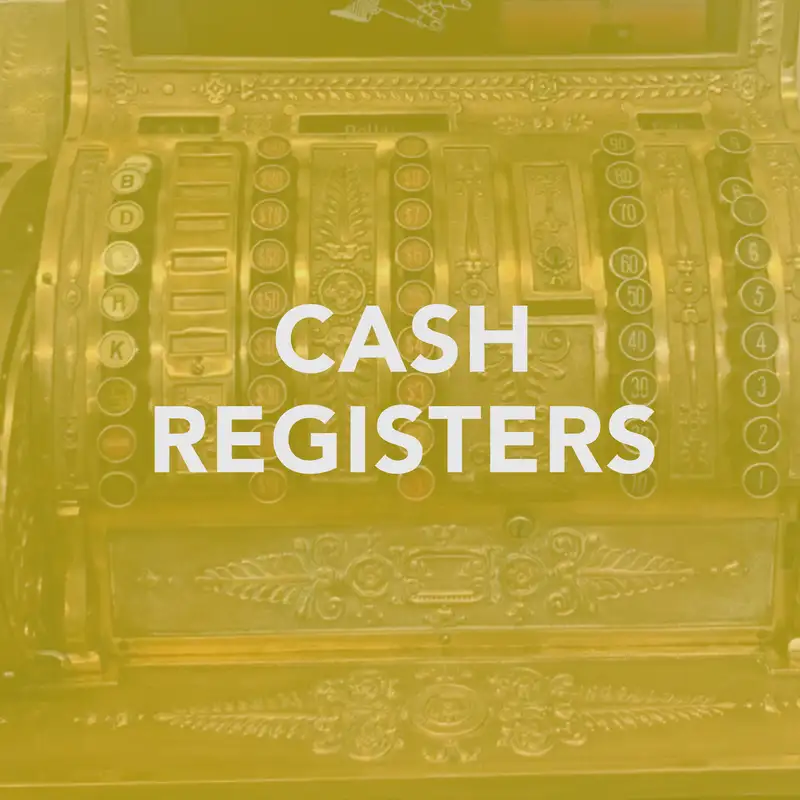
Dan Slimmon: in its heyday, National Cash Register produced some beautiful machines. I'm gonna show you a picture of one of these machines, So here's one of their, here's one of their machines.
Daniel Ryan: [00:52:00] Yes. Yeah, that is, that is exactly what I was imagining, like, old, old-timey cash register to look like is that thing.
Dan Slimmon: It's beautiful
Daniel Ryan: It is
It's got the, it's got the nice pointy hand to, to show you where to look. I like that
Dan Slimmon: It's got the, it's got the little, yeah, it's got a little, little like acid-etched f- finger-pointing hand. It's like, "This is how much you're paying." Um, it's got that, uh, icon... It's got this like ornate scrollwork all over the, the casing, which is in polished brass. Um, even between the, even between the rows of buttons it's got these little f- um, flower, flowery designs.
Daniel Ryan: It just looks like it would be very satisfying to use too. Like, it would make, like, very good, like, tactile sensation, like pressing those buttons
Dan Slimmon: Yes. Coo- they go ka-chunk.
Daniel Ryan: Yeah
Dan Slimmon: Yeah. It's gorgeous, and I wish my MacBook looked like this
Daniel Ryan: I wish more things [00:53:00] put care into the design instead of everything being interchangeable, so-called minimalist bullshit. But that, that is another rant, I would save that
Dan Slimmon: Yeah. Everything's fucking knockoff m- made in Apple by-- or made in, uh, California by Apple
Daniel Ryan: And even Apple used to, like, they used to make the computers in different colors. Like, they
Dan Slimmon: Right
Daniel Ryan: pretty. They were interesting. I... It's fine. It's fine.
Dan Slimmon: No. Nope. No longer, no longer can you get a machine that looks like this, which is, um, too bad. They were heavy, but, uh, I'd be o- I'm okay with that. Um, I, I also wish my MacBook made the same, uh, sound that these machines make, which I will play for you now
Ah, yes
That's the first cash register drawer, and here's the [00:54:00] second cash register drawer. Ah
Daniel Ryan: Oh
Dan Slimmon: Beautiful
I can't get enough of that sound. I don't know about you. I think that's amazing
Daniel Ryan: Isn't there some song that I'm forgetting right now that has l- like a chunk, chunk, chunk, chunk, like s- that sampled a cash register sound and it was very satisfying?
Dan Slimmon: There's a couple, um, there's, uh, there's Pink Floyd's "Money," which starts with the, um, which starts with a lot of different cash register sounds and the cha-chunk and the ding, and then there's, um, "Paper Planes."
Daniel Ryan: That's the one I was thinking of.
Dan Slimmon: yeah.
Daniel Ryan: somebody remembers MusicSounds.
Dan Slimmon: Uh, yeah, that's such a good s- and, and that was like, that song came out fucking 30 years after cash registers were no longer really a thing.
But that sound, that ch-ch-ding, is so good and so iconic. [00:55:00] We all know what that means. Um, yeah. And of course, cash registers didn't say this-- didn't stay this beautiful forever. Um, we, uh, the one I just showed you was a model from the early days of NCR, uh, when it was run by an obsessive maniac who was trying to invent B2B sales.
This is what National Cash Register, uh, National Cash Registers products looked like by the 1950s
Daniel Ryan: Boo.
Dan Slimmon: Boo. No more brass. It's just beige sheet metal, plastic buttons, rubber cash drawer. Sucks
Daniel Ryan: It is so beige. Like, the, the, the red buttons are, are, are a nice burgundy. I'll give them that, but the
Dan Slimmon: Yeah. They got rid of that eventually.
Daniel Ryan: Of course they did
Dan Slimmon: It's all, it's beige as hell. It's got lines where it doesn't need lines. Uh, it's, it's still cooler than [00:56:00] a fucking Clover iPad though. I'll give it that
Daniel Ryan: Yeah. It's got that little zigzag down. Why does it zig in the middle there?
Dan Slimmon: I mean, it ziggs where it should've zagged. I don't know
Daniel Ryan: It, it could have just been a straight line though. I just, it's...
Dan Slimmon: Yeah. I don't-- It's, it's, it's not, it doesn't even, it doesn't compare at all to the... But so that's sort of the difference is like here when back at the Br-Brass Designs, they were trying to make people want cash registers, and we'll get to this, but by the 1950s they didn't have to do that anymore. You had to have a cash register.
Daniel Ryan: And everyone already had one, so then they could just be like, "Oh, remember this thing that you, that you're used to that used to be good? Have a replacement. It's just gonna suck a little more
Dan Slimmon: Yeah. What are you gonna do? Count up m- money yourself? We pr- we privatized the, we're, we're working on privatizing the education system now, so you won't be able to do math [00:57:00] either Um, blows. Anyway, that's, um, that's what they, that's what they used to look like. Oh, those days are gone.
The cash register integrates machinery with the worker's body
---
Dan Slimmon: Now, by the way, when we had the picture up of the brass register, the brass early cash register before, did you notice the hand crank on the side?
Daniel Ryan: Yeah, that looked like a very satisfying hand crank
Dan Slimmon: It did. Um, I, yeah, I would like it, I would like it if I had to crank my, my laptop with a hand crank to make it, to make Claude answer code questions for me. Uh, they should just, I-- th-add that as like a little psychosomatic thing to make me feel like I'm doing something now that I don't have to write in my own code.
So those, those were hand... The early ones were hand-cranked machines. There was no motor in them. And I think that was actually part of the beauty to a man like Patterson. You got this ornate, meticulously designed machine that with the, with the bell, [00:58:00] and the worker is turning a hand crank to every sale he makes, he has to turn the hand crank to sort of prove he's not stealing.
It's all part of this one cohesive, orderly system. an orderly system is the one thing John H. Patterson truly loves. Did I mention he had a wife and two kids?
Daniel Ryan: I don't think so.
Dan Slimmon: His wife was Catherine Beck of Brookline, Massachusetts. They married in 1888, and she died in 1894 at the age of either 28, 29 or 30, depending on whom you read, either of diphtheria or typhoid, depending on whom you read.
Daniel Ryan: Very
Dan Slimmon: of
Daniel Ryan: to die of in those days
Dan Slimmon: Yep. Everybody's just dying left and right, and why write, why write it down which one it was? Doesn't, doesn't matter. Neither of Patterson's biographers records any emotional response by the man to his wife's death. Just keeps on [00:59:00] chugging.
Patterson's love for systems
---
Dan Slimmon: But, but he loves systems. That's his true love. And you can hear, you can see how this love of systems makes him into a titan of industry. He's got a system for direct mail. He's got a system for salesmanship, a system for training salesmen. He's got systems for production, for distribution, and if you come to meet John Patterson in his office, you'll see he's even got a system for systems.
Daniel Ryan: I, I
Dan Slimmon: Behind his desk... Yeah, of course he does. Of course. He's got this big blackboard behind his desk with five columns drawn on it all the time. The columns are labeled mentally, morally, physically, socially, and financially
Daniel Ryan: All right
Dan Slimmon: And anytime somebody comes to him with an idea, he'll have them, he'll have them explain it, its, its, its implications in each of these categories, and he'll write it down and they'll evaluate the idea together on the blackboard[01:00:00]
Daniel Ryan: To make sure it... D- does, does an idea have to hit all five or is it like a, like
Dan Slimmon: Yes.
Daniel Ryan: Okay
Dan Slimmon: We don't, we don't get a lot of-- I would assum- I would assume so, and I, I, I'm pretty confident in that for the reasons we're about to go into. But, but I never-- We don't get a lot of detail on what, how the system was actually used. He was very proud of his idea systems.
Intense fiveness
---
Dan Slimmon: so it's no coincidence that there are five categories on the blackboard, because five is a holy number to John H. Patterson. He seems to have read early in the 1890s some piece of, like, Helena Blavatsky-adjacent Victorian mystical hooey about five being the number of greatest cosmic significance because, like, the Egyptian pyramids have five sides or whatever, and that proves that God is, is-- God loves five.
Um, from a writer in this pyramid hooey movement, we have this, quote, [01:01:00] "This intense fiveness could not have been accidental and likewise corresponds with the arrangements of God both in nature and revelation. Note the fiveness of termination to each limb of the human body, the five senses, the five books of Moses, the f- twice five precepts of the Decalogue
Why is five? Come on.
Daniel Ryan: Yeah, that's,
Dan Slimmon: That's te-
Daniel Ryan: stretch
Dan Slimmon: now two's involved? Get the hell out of here, two. Fuck off Uh, he, uh, I don't know, and he just reads this and he's like, "Oh, well, that makes perfect sense. Of course, five." Um, it's really funny to me the way Pattern gets-- Patterson gets obsessed with five because as we've established, the man is not a reader.
But he kn- he reads one kooky pamphlet on the pyramids, and it, it immediately becomes the way he thinks about everything.
Daniel Ryan: Everything
Dan Slimmon: these guys who you meet at DevOps conferences who just finished reading "The Goal." [01:02:00] Uh,
or the, or "The Phoenix Project," and they're just like, "You don't know about it. You're a Brent. Everybody's a..." You, you, like, they got this whole vocabulary and system. And I was one of those guys for about six months after reading, uh, "The Phoenix Project." I ge- I get it.
I, I see how this happens to people's brains
Daniel Ryan: Yeah. I mean, we all went through that phase.
Dan Slimmon: Yeah.
Um, but John Patterson's obsession is not DevOps, it's five. A customer in a store, he wr- writes, does one of five things: buy for cash, buy on credit, pay on account, collect a bill, or change money. There are five kinds of money: gold, silver, copper, nickel, and paper
Daniel Ryan: All right.
Dan Slimmon: can only, we can only guess what John Patterson would've made of Bitcoin
he will often write, like I said, he will often write these articles and give lectures to employees on various topics. And his topics are things like, "The Five Things a [01:03:00] Salesman Must Do," "The Five Things a Salesman Must Not Do." And
Daniel Ryan: he invented BuzzFeed listicles
Dan Slimmon: he invented, oh my God. Daniel, I didn't even think about that. Yes, he invented the fucking listicle.
This guy
Daniel Ryan: five types of money. Number four will shock you
Dan Slimmon: Yeah. and it, and it really was clickbait, right? but then instead of getting people to, like, actually, be interested in it, he, they had to read it because he told all their wives they had to read it he, he also writes this thing, um, this thing called "The Science of Selling," which is an article, to quote that, uh, "A sickly, nervous man cannot exert that personal magnetism which unconsciously cuts such a large figure in the success of every salesman.
Good health and abundant animal spirits are perhaps the most important qualifications for a salesman can have for his work."
Daniel Ryan: Yeah, that, that checks out. He, he, he predicted/invented sales bros
Dan Slimmon: [01:04:00] Yes. I've met so many, I've met so many sales bros who believe they have the best animal spirits Oh, the reason I could sell so many, so much software is because of my personal magnetism
Daniel Ryan: And the tiger spirit deep within me
Dan Slimmon: Yeah. I think this stuff Right. Right. What's your spirit animal? Dude, we don't do that anymore. St- Now, of all Patterson's pyramids, the most important is National Cash Register's org chart. Always his name is at the top of the pyramid in the abode of the sun god Ra, and the pyramid org chart has exactly five layers, of course.
Daniel Ryan: Of course
Dan Slimmon: cause everything's, it's all, it's fives all the way down.
Fractally, fractally five inside this guy's mind.
Five kicks ass
---
Dan Slimmon: Now, by the way, don't get me wrong, I've got nothing against five. Five kicks ass,
Daniel Ryan: It's a good
Dan Slimmon: all right? It's a great number. It's the fifth [01:05:00] Fibonacci number. That's fine. Five is the Fibonacci number number five. That's cool. It's the hypotenuse of the smallest Pythagorean triple, so the three, four, five triangle.
That's, that rules.
Daniel Ryan: It's a
Dan Slimmon: There exa- It's a prime number. It's the, it's, it's, um, it's the, it's a safe, it's both a safe prime and a good prime, I think. I lo- I don't remember exactly what that means, but the number theorists all have all these names for, um, different kinds of primes, and I think it's a safe prime and a good prime, which, which is cool.
There's exactly five Platonic solids, um, which are, of course, the D4, the D6, the D8, the D12, and the D20.
Daniel Ryan: My
Dan Slimmon: That's what those are called. Yep. Fuck the D10. Not a Platonic solid. Get that, get the D10 out of here.
Daniel Ryan: Ah, so that's why D10 systems are the worst role playing systems.
Dan Slimmon: Exactly. We've, we cracked the code.
Daniel Ryan: We figured
Dan Slimmon: Patter- [01:06:00] Patterson would've hated those So five, five is a lot of cool stuff. Five is also the number of titular queer guys on Queer Eye for the Straight Guy
Daniel Ryan: That is true
Dan Slimmon: There are five of them. They, and I, I really think, um, Patterson would've been darkly obsessed with Queer Eye. There, first of all, there's five guys, and second of all, they, they're, they, what they do is they find someone with a messy, unconventional way of living. They tell that person how to live their life,
Daniel Ryan: They've got
Dan Slimmon: and they have a system.
They tur- Right, exactly. They turn that person's chaos into order with their, with their system. And I could imagine John Patterson having, like, a Victorian-era version of, um, Queer Eye for the Stra- Straight Guy, where he tells people how to, how to live
Daniel Ryan: Or maybe he just wanted five, whatever the equivalent, what were, dandies? Five,
Dan Slimmon: Yeah.
Daniel Ryan: men to come tell [01:07:00] him how to... What, what was he doing? Was he, he's, was he the one who was taking all the baths? he take
Dan Slimmon: yeah, we're gonna get to the, we're gonna get to the bats. I think it was, I think actually it was five minutes. Um, yeah, you, you, you get him. You, you, you get John Patterson now. Um,
Daniel Ryan: upsetting
Dan Slimmon: yeah, well, that's, that's this show, baby. yeah, amazing, amazing man.
Order: John Patterson's God
---
Dan Slimmon: And, and order, really. Order was the defining principle of John Patterson's life.
He had a soul that was hardwired to impose order. Short-circuited even, I would say, to impose order. From, from fives to, to pyramids, to his total restructuring of the NCR work environment according to his single enlightened vision, all the way to his zealous devotion to the cash register, a machine that fixes the flaws in the retail employee [01:08:00] by integrating his body into the arithmetic of bookkeeping.
John H. Patterson was, in every respect, a paladin to the god of rational order, which at the turn of 20th century is capitalism itself
Daniel Ryan: It sure was
Dan Slimmon: and we're gonna talk about How, how that informed the entire way that he lived and forced others to live in part two. But for now, we're gonna cash out. So
Daniel Ryan: What a
Dan Slimmon: thank you for... Th- th- I know. Um, that's how you, that's how you keep 'em coming for more cash register stories.
Uh,
Bye bye
---
Dan Slimmon: Daniel, thank you so much for being here for this. Um, uh, and I don't, I make no apologies for exposing you to this man
Daniel Ryan: Thanks for having me
Dan Slimmon: You got anything you want to plug?
Daniel Ryan: I do not. Technology is terrible. Go outside, climb a tree, get some fresh air, maybe by
Dan Slimmon: Yeah
Daniel Ryan: maybe not[01:09:00]
Dan Slimmon: Look for a tree that has, uh, four or six branches.
Daniel Ryan: Yeah, not
Dan Slimmon: Yeah. Fuck John Patterson. Don't climb a five-branch tree. Um, and while you're out there, follow Tech Blows on TikTok, follow me, @dancelimmon on Instagram, subscribe to Technology Blows on YouTube, all that shit. You know, just devote your entire persona to this podcast the way John H.
Patterson devoted his to the cash register, and join us next week for part two on cash registers. So long from me and Daniel, and so long from Technology Blows