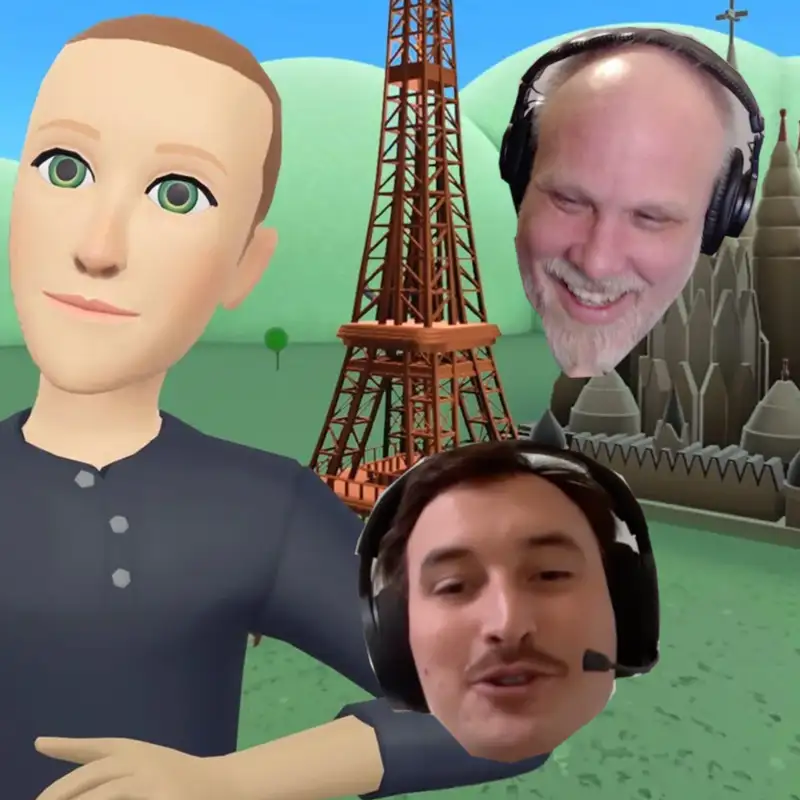
Horizon Worlds: Mark Zuckerberg's legless VR utopia (Part 2)
Download MP3Episode 17: Horizon Worlds: Mark Zuckerberg's legless VR utopia (Part 2)
===
Intro
---
[00:00:00]
Dan Slimmon: Welcome back to the Metaverse listeners. You've stumbled across part two of our three part Look into Horizon Worlds Mark Zuckerberg's virtual reality utopia, where everyone is capable of super empathy on account of these space age goggles they're wearing.
If our last episode was technology blows into the Metaverse, then this is Technology Blows across the Metaverse. And I'm your host, Dan Slimmon. Joining me today again, is none other than up and coming. LA based [00:01:00] comedian Anderson. Gronvold, my nephew. Go ahead, Anderson. Say hello.
Anderson: I'm, you know, I'm honored to be back for part two.
Dan Slimmon: Yeah,
Anderson: was, uh, I gotta be honest, a little horrifying, but, uh, I can't, I can't let you keep going deeper into the metaverse alone.
Dan Slimmon: yeah, there was some bad stuff in that episode. And I'm not gonna lie, Anderson, there's some bad stuff in this episode. There's some good stuff, but there's, um, you know, it's a real, it's a real mixed bag.
Anderson: I am, I'm more prepared this time. Last time I was fighting out about like modern horrors live. During recording, so I should
Dan Slimmon: Uhhuh.
Anderson: this
Dan Slimmon: Um, that's, I should probably send people like a, like a form to sign off that they're willing to hear about how horrifying the modern world is before they get on the podcast.
Anderson: Yeah, true. It's kind of baked into the name. Technology blows though,
Dan Slimmon: right. It's not, technology is very comforting. Um, that's a, that's [00:02:00] a different podcast.
Anderson: Different podcast and uh, fuck those guys. Hate them.
Dan Slimmon: Yeah, Alright. Uh, ready to get back into it, Anderson.
Anderson: Let's do it.
The Quest owns the market
---
Dan Slimmon: So, by 2021. Facebook has around 10,000 employees working at Reality Labs, which is what used to be Oculus, and is now Facebook's vr slash ar wing.
As a refresher, VR I think everybody knows is virtual reality. AR is augmented reality. So it's with the, with the special Facebook glasses that make everything, make like holograms appear in your world like a penguin who's jack in it. And, uh, the meta, the, the Facebook headset, uh, the Oculus Quest two is the, the leading head-mounted display on the market by an, by an enormous margin.
the Oculus Quest accounts for 78% of VR headset shipments in 20 21, 70 8%. and that's partly because it's really good, [00:03:00] you know, uh, they're, they're pretty far ahead of the pack technology wise.
Uh, they've, they've got a big head start from, from electronics, wunderkind, and Hawaiian shirt Wearing America First, dipshit, Palmer, lucky, who, who got them a pretty good product in the first place. and, and also like they've just poured billions and billions of dollars into r and d since acquiring Oculus in 2014.
And nobody else has poured that much money into building a good VR headset. So they came up with a pretty good one. That's not the only reason. They have a 78% market share, though. Uh, the o The other reason is that they're selling these things for super cheap. it's 300 bucks for one of these babies. By comparison, next most popular consumer grade VR headset, the valve index goes for 500. and, and the reason the Oculus Quest is so cheap, of course, is that Facebook is betting big on controlling the platform.
You know, they wanna become the only place to, to buy VR avatars, sell VR ads, process pay VR payments, all this [00:04:00] stuff. They want to come through Facebook so that they don't have to keep paying Google 30% of their revenue for Google's, you know, mobile platform, et cetera.
So they're thinking, well, we can avoid, we can lose money on the headsets because we we're gonna be the only VR platform. And again, in a collective delusion that almost makes you wonder if the CIA is somehow like secretly dosing everyone on the Facebook executive floor with LSD through the air events, that everybody in Facebook thinks that VR is gonna be the next mobile.
Like that's how everyone's gonna be using the internet by 2025. So of course they can afford to sell the, the headsets for whatever 'cause their, it, their earnings from being the only VR platform is gonna like dwarf and whatever they lose on that. it's crazy Their headset is coupled to their like VR software platform, but they, they can't just their, according to their strategy, right? They can't just build the [00:05:00] platform. I'm gonna, uh, that 2015 memo again from Mark Zuckerberg is illuminating here, where he lays out his reasoning for going all in on vr.
He says, if we only build key apps, but not the platform, we will remain in our current position. If we only build the platform but not the key apps, we may be in a worse position. We need to build both. Uh, so they need, they need, like, they need both the, the, the hardware and the platform that lets people use the hardware easily, um, and, and interact with the metaverse.
And they also need to own like a, a, a significant portion of like the apps that people are spending time in, in VR is their, is their strategy.
Anderson: tell me if I'm wrong, but he, that's not profound at all. Right? That's like a,
Dan Slimmon: No, it's, it's like, it's, thank you for saying that because like I read, I read this and I was like, uh, I don't, [00:06:00] you know, I'm not, I'm not gonna say Mark Zuckerberg is a, is an average dumbass, but he keeps making decisions and, and making statements that an average dumbass would make.
Anderson: When I heard it, I was like, surely there's another layer to this. And then as you were finishing talking about it, I was like, no. He's basically
Dan Slimmon: No,
Anderson: we have to have the Metaverse platform and then it also has to be enjoyable.
Dan Slimmon: yeah, yeah, Uh, we, we have to,
Anderson: you see why this guy's leading the whole thing.
Dan Slimmon: right. You see, if we, if we could make money from having one thing. Imagine how much money we could have by making three things. Think about that.
Anderson: Guys, if people want to buy this, we are set. I.
Dan Slimmon: so,
Horizon Workrooms
---
Dan Slimmon: so let's check 'em out. Let's, let's talk about these, let's talk about these key VR apps that Facebook so desperately needs to succeed with. by 2021, they, there are a couple main VR apps that [00:07:00] they've got. One is called, one is called Horizon Workrooms, which, which, uh, which launches in August of 2021.
And this is like a virtual office software that lets you sit in a virtual office at a virtual desk and watch your virtual coworkers draw on a virtual whiteboard while you physically die. Uh.
Anderson: was one of the first things they, they were like, well, obviously people are gonna want to be in office
Dan Slimmon: Yeah. Yeah. What do, what do, what do people love? What do people wish they could do that they can't do? Oh, you know, it's, it's COVID. So, you know, what, what, what can we give, what experience do people love that we can give them in, in virtual reality? I know.
Anderson: Yeah, we now have a platform that can generate anything imaginable. Let's put them in the office.
Dan Slimmon: Yeah.
Anderson: It's
Dan Slimmon: And that's gonna be a, that's gonna be a theme. And it's crazy. These people have no idea what people [00:08:00] enjoy. so asked in 2022 to give an example of what makes the quest so useful. Meta's Vice President of Metaverse, Vishal Shah. told a story about how his team all got together in workrooms and told stories about their recent vacations, and the interviewer was like, oh, this is gonna be cool.
People are gonna have like 3D videos that they took of their vacations that they can like all jump into in the metaverse to, to have this conver, this could actually be kind of cool. so he says, if you've been on a big zoom call with, you know, a bunch of faces, this is awkward. But we were all in a workroom. I told my story, I looked to my left, the next person went, and then there were head nods and acknowledgement, and then we just went around the room.
Right? Whoa.
Anderson: God. Crazy.
Dan Slimmon: we did it. Yeah. I guess the, I guess his point is that like, [00:09:00] you don't have to do the thing in Zoom where you're like looking at the, where somebody looks at the, attendee list and goes in order and like calls their names in order. You don't have to do that. You can just like look over to your left and somebody else can tell a story, but like, that's what they've got.
That's the best, that's 2022. thing they've got and Right. What makes it so useful? Well, here's a, here's a story.
Anderson: down for this one.
Dan Slimmon: Yeah. Yeah. Are you sitting in real life? I can tell your, I can see your avatars sitting, but that doesn't mean you're sitting. yeah. That's, that's what they're into.
this is what you, this is what happens when you get a, when, A com, a company like Facebook where people have become successful by working nonstop and doing what Mark Zuckerberg, whatever Mark Zuckerberg wants to do. And so that's all they can think of to do in their life, I think.
Like that's, that's what life is to them.
Anderson: They have no reference of Of the, of the outside.
Dan Slimmon: Right. They've been in building 44 since they were [00:10:00] born. Uh, he's, he's breeding, he's breeding executives there.
Anderson: a nice little nutrient broth.
Dan Slimmon: Mm-hmm. Mm-hmm. All right, so that's Horizon work rooms, um, which sounds like, it sounds like something that would be like discovered in a, in an a, a previously abandoned house in New Mexico and like they pull 200, uh, you know, human trafficking survivors out of the horizon. Work rooms. Uh,
Anderson: I bet this was originally in the script for severance, and then they're like, ah, shit. It's a real thing. Now we have to rewrite
Dan Slimmon: yeah, Zuckerberg. Um,
Horizon Venues
---
Dan Slimmon: the other key app by 2021 is horizon Venues. Which launched a, uh, way back in 2018 as a VR concert venue. And Horizon venues has a couple of different kinds of events. Sometimes it's a virtual concert, sort of where the performers are on a virtual stage, so in that kind of concert, the stage can be [00:11:00] like whatever you want.
It can be a cavern of flame that they're performing in. It could be a futuristic spaceship, cyberpunk, cityscape, and the performer is like an, it could be a gray office with a whiteboard. David Byrne would do that one. I, I think, that I, I just side, side note, I, one of the most like.
Affecting parts of a musical performance that I saw was when I saw David Byrne, uh, last year. And, uh, he had, they were performing in front of he and like 12 other people, um, are like dancing around performing on, on the stage in the background is this like gray office park office with just like it's that for the whole performance. And then like 15 seconds before the end of the song it switches to like a field of golden wheat. It just like two static photos. But after staring at the gray office for two minutes and 45 seconds, you see the wheat [00:12:00] And everybody in the audience was like, holy shit, this is incredible.
Anderson: Wow, that is, uh, that is very, uh, dystopian.
Dan Slimmon: Yeah, it's good. It was good stuff. so yeah, you, you get the performer on the stage, um, and your point of view in this kind of concert is basically you're on stage with the band and they, there's like a camera set up on stage with the band, and you are the camera. the, and the, uh, performer will sing directly at you.
incredibly awkward. It's, it's the, it seems like the worst possible way to SI can't imagine a worst way to, to watch a whole concert. Like, it's like at, at every concert you've been brought up on stage to be serenaded by, by the singer, uh,
Anderson: audience.
Dan Slimmon: with no one else in the audience. Just you and the band. Yeah, I'm gonna show you a bit of a Sabrina Carpenter [00:13:00] concert from 2024.
Anderson: I can't wait.
Dan Slimmon: You never,
Now she's coming toward us.
Anderson: She's coming.
Dan Slimmon: And then
If you're watching meta, I want you to scream at the top of your, wherever
that part's really fun because there's no audience. Um, so I don't know who's doing the screaming. They, they like added, they must have added the sound of an audience screaming in and post to that part.
Anderson: Yeah, I'd love to know who collected that audio.
Dan Slimmon: Yeah.
Anderson: down to the horizon work rooms and recorded whatever they do on a normal Tuesday. They're like, thanks. We got our scream audio.
Dan Slimmon: Yeah. Yeah. No, Vishal not again.
Anderson: So basically like [00:14:00] sa, they're on the set, like Sabrina Carpenter and those people are on a physical set, and then there's just a portal that allows people to tune in with vr.
Dan Slimmon: Mm-hmm. Mm-hmm. Mm-hmm. I think I could watch about 30 seconds of it before being forced all the way offline by visceral shame. So that's one kind of horizon Venues concert. The other kind is where there's an actual physical concert happening somewhere in the real world, and Facebook has set up like an omnidirectional video camera to stream that event from a certain seat in the audience.
So you're watching a real event, you know, foo Fighters concert, for example, is one that they did, and you can look around and see everything that's going on. You can see the rest of the audience, but you're not really there. You're, you're just a camera. Um, they did this for UFC for some UFC fights where you're like down next to the octagon and you can see that you're right by right in [00:15:00] the action.
Um, which, which is probably cool if you're into UFC, which Mark Zuckerberg definitely is now. Um, but I, I feel like the, I feel like the UFC experience just isn't the same without the smell of a thousand sweaty men, man.
Anderson: I agree.
Dan Slimmon: and like we, like we said last time, they haven't figured out how to pipe that sweaty man smell into your nostrils yet, but, but don't, don't bet against z He'll get it.
Anderson: on it though.
Dan Slimmon: Yep. Yep. Somebody. Yeah. Prob there's probably a whole community of moders who are on it. yeah. Anyway, to, according to a screenshot from May of 20 22, 50 5% of the Oculus store reviews for horizon venues were one star reviews.
a lot of these reviews are complaining about the, the space, like the lobby of the venue, just being full of children running around and screaming. And a lot of them also describe sexual assault and, and harassment. So it's not good.
Anderson: It never takes long to get there.
Dan Slimmon: no. So like, probably the single worst possible [00:16:00] way to see a concert,
you know, but there are people using it who like it. And who think it's, I I think it's probably like people who are largely people who are desperate. You know, it's 20 20, 20 21. People who are desperate for, for any kind of communal experience in the depths of the COVID-19 pandemic. Um, right. Just gimme anything, anything where I feel like I'm around other people.
Anderson: Sure.
Dan Slimmon: right. Which, which, which seems like it was a, maybe a golden opportunity for the metaverse to take off, but they, I think they missed it. Um,
Anderson: yeah, if there was ever a time to launch,
Dan Slimmon: right,
Anderson: the window.
Dan Slimmon: exactly. Yeah. They, they, they got so lucky and they fucking fumbled the bag, um, by building this horrible software that sucks. and you know, who else was desperate around 2021?
Mark fucking Zuckerberg. Uh, because Facebook [00:17:00] is absolutely drowning in intractable problems in 2021. their, their platform is spreading COVID-19 vaccine misinformation. like it's COVID-19, and Facebook leadership wants to stop the COVID misinformation. They really do, but it just keeps getting worse because they don't actually have the balls to censor people.
so they're like, well, what if we promote certain posts to make, um, the, you know, that, that we know are, have like government certified information about COVID-19 vaccines, but they still have the comments on, and the comments get like filled with, people being like, vaccines are killing your pets. And, they actually end up amplifying those comments more than if they had just not posted the promoted content in the first place.
Anderson: It's like, it's like troll bait.
Dan Slimmon: Yeah. so that's a big problem that they can't solve. Uh, in April of 2021, somebody drops a data leak on a hacking forum with the personal data of over 500 million Facebook users. We're [00:18:00] talking full names, phone numbers, locations, birth dates, email addresses for 500 million people.
Anderson: Yik.
Dan Slimmon: This is a fun part of the modern,
Anderson: check.
Dan Slimmon: you probably were. Yeah. I think I had left Facebook like three months before the, before the data got stolen. So I'm not in it, but I'm in. This is a part fun part of the modern world is that, um, every few months you find out that some company you've never even heard of had your social security number and they accidentally lost it.
They don't know where it is now.
Anderson: Yeah, it's like which, which mega corporation is doxing you.
Dan Slimmon: But anyway, this Facebook one was really bad. And then in September of 2021, the Wall Street Journal starts publishing this blistering series of articles called the Facebook Files.
And they're just like airing all of Facebook's dirty laundry, which they can do thanks to the, the work of Whistleblower Francis Haugen. they, they write about how Facebook has failed to curtail human trafficking on their platform, [00:19:00] they write about how Facebook drives teenagers into eating disorders and radicalization and suicide, and they refuse to fix that problem. They break that COVID misinformation story. and, and perhaps most importantly. In all this reporting, it's clear that Facebook knows about all these problems.
They know how bad these problems are and that they're getting worse, and they either can't or won't do anything to fix 'em. it's a real pain in Mark's ass that, that, that people keep writing about this.
Anderson: Yeah, the guy's trying to build the metaverse.
Dan Slimmon: Yeah. Don't you understand?
Anderson: This universe, this world doesn't matter anymore.
Dan Slimmon: Yeah, maybe, maybe those teens wouldn't have. Nevermind. Um, the, so, uh, and, and so anyway, we come to, um, so, so it's a bad year for Mark Zuckerberg. His head hurts, his neck, hurts his ass is killing him. He starts to think to himself.
Wouldn't it be nice to not be CEO of Facebook anymore if I just, if [00:20:00] I could just not be CEO of Facebook and I, I understand it.
Meta's 2001 keynote
---
Dan Slimmon: So that's how we come to October 28th, 2021, the day Mark Zuckerberg gets exactly what he wants to no longer be CEO of Facebook. This is the day of the most delusional tech company keynote I've ever seen.
And, and Anderson, I've seen some doozies.
Anderson: That's saying
Dan Slimmon: so so, okay. So it starts with Mark Zuckerberg getting a call from a friend who wants to hang out with him, which already feels kind of false. Like, you're, you're stretching my, you're stretch, you're stretching my belief here.
Anderson: You can
Dan Slimmon: Um,
Anderson: of the PR company all over this,
Dan Slimmon: and so he selects his metaverse. He's like, my friend, his friend wants to hang out in the metaverse, so he selects his metaverse avatar and he scrolls through a few choices on this. Like he's, there's a life, he's got a life gr life-size hologram of himself in his, in his living room that he is using to choose his outfit.
[00:21:00] And he like flicks his wrist and, uh, it's wear, it'll wear, it's wearing different outfits.
Anderson: You
Dan Slimmon: and you, I've
Anderson: other people's skin just,
Dan Slimmon: right?
Anderson: different things. He, you know, he's always
Dan Slimmon: Yeah. Just thinks he likes to wear. Um, yeah. I kept thinking when I saw him flicking through it, well I was, I kept thinking he was gonna like accidentally flick one outfit too far and it's wearing like bunny ears and a leather harness and he is like, oh, um, ha ha ha. Lemme
Anderson: The next day somebody's fired, like publicly.
Dan Slimmon: There's no way Mark Zuckerberg doesn't fuck this hologram.
Right? I mean, I'm like, I don't believe you can be a billionaire with a life-size hologram of yourself in your living room and not be fucking that hologram.
Anderson: I'm, yeah, I'm, I'm not even saying I'm, I'm better than him and I wouldn't, but I don't have a billion dollars or a hologram of myself in my living room.
Dan Slimmon: Right? Right. If somebody, if Mark, mark Zuckerberg, if you're listening, if you want us, if you wanna buy me a hologram of [00:22:00] myself to put in my living room, I'll fuck that hologram.
Anderson: I'll show you.
Dan Slimmon: Call me up.
Anderson: man's
Dan Slimmon: Yeah, that's right. so, so he picks this outfit, he picks the one with the same nondescript, dark sweater and pants that he's wearing in real life.
Anderson: Good choice Mark.
Dan Slimmon: great choice. Nobody will make fun of you now.
Uh.
Anderson: the, uh, the potential of the metaverse.
Dan Slimmon: Yeah. Can you imagine, uh, a world where you could be wearing the clothes you're wearing now?
Anderson: Yeah, exactly.
Dan Slimmon: so the camera, as soon as he picks his outfit, he says, all right. And the camera sort of swings through the room and jacks into the back of the avatar's head, and we're in the metaverse. And the first thing you notice as Mark walks into the like shiny white spaceship cabin where he's meeting all his friends to play cards, is all of Mark's best friends are people who work for him, which, [00:23:00] which honestly tracks.
you got, you got Andrew Bos Bosworth, who's now the CTO of Facebook is there. Um, he's, he's a, he's a huge bright red robot, and there's a bunch of other Facebook executives there around the table, and they're all playing cards. The cards are floating in, in midair, and they, um, I I, I slowed it down to like quarter speed to try to figure out what card game they're playing, but it's, it's nonsense.
They're just, they're, there's a, it's a cool card animation. They're not actually playing a card game.
Anderson: Nice.
Dan Slimmon: so immediately, the first thing they've decided to tell me about the metaverse in this keynote is that it's the worst possible place in fucking creation.
It's like, okay, cool. So if I go to the Metaverse, then I get to what? Hang out sober in a space hotel with the C-suite of Facebook. Here's one, just one of the uncountable dumb things that happen in this keynote. this is Boz, red, the red robot from before, um, [00:24:00] talking to Mark Zuckerberg about augmented reality.
I gladly nerd out with you on the technical details of this with you. I know, but I think it's better to show you load the world beyond. This is oppi. Oppi come. Come on. Oppi. Who is a good persistent state virtual object layered on an interactive pass through environment. Oh you are? Yes, you are. Oppi. Sit pets in the Metaverse man. Just as stubborn as they are in the physical world. You know, Boz, I always really wanted a forest in my living room.
Did you? Not really.
Anderson: It is worse than I imagined.
Dan Slimmon: It's incredible. how would you, hold on, let me, uh, load the world beyond. here. I'm gonna load a picture of, uh, Oppy for a second. Describe Oppy for the listeners. Uh, right.
Anderson: [00:25:00] looks like a virtual rabbit
Dan Slimmon: Yeah.
Anderson: fuzzy ears and big eyes, and, uh, look like he better do what he's told or else.
Dan Slimmon: Yeah. Boz does not love this thing.
Anderson: No, no, no. I want, I wanna speak to API alone for a second without
Dan Slimmon: Yeah.
Anderson: room.
Dan Slimmon: Yeah.
I would describe API as, um, bis quick faced would be my main, my main descriptor for, for
Anderson: But yeah.
Dan Slimmon: Oppy. yeah. It looks like a kind of a rat wearing like a, like a very slutty amount of eyeshadow.
Anderson: Yeah. And lip and lipstick too.
Dan Slimmon: Yes.
Anderson: That looks
Dan Slimmon: Um, yeah. I don't, somebody, whoever designed this has some skeletons in their closet, I'll tell you that. the forest [00:26:00] in the forest in my living room. Bit like who thought that was? They wrote that they, that was written, that was a joke written for them.
Anderson: that made it through multiple rounds of approval.
Dan Slimmon: Yeah. Right. uh, no, it can't be, it can't be anything funny. here's another of the dumb things that occurs in this video. I mean, there's just so many. I could just show you the whole video, but we don't have time. You should a, anybody at home who is interested in seeing. Like the, the, a masterclass in techno solution is hogwash.
watch, go watch this video. It's called The Metaverse and how we'll build it together. Connect 2021. But here, Anderson, I'm gonna show you another clip from this. Um, this is the Michael Abrash, the leader of Facebook's research team. and he's, showing us one of the things that they're working on in their, uh, augmented reality program.
Here, remember the mock apartment we saw earlier? Well, we've indexed every single object in it, including not only location, but also the [00:27:00] texture, geometry, and function of each one. We fed all that information into the project RA glasses Ming Fay is wearing in this next demo. And the reason is to simulate how AR glasses will ultimately be able to access data from a 3D map. What's happening here is that the glasses are calculating where Ming Fe is in the room locating and identifying all the nearby objects based on the index mentioned earlier, and figuring out which of those objects Ming Fe is interested in by observing her eye movements.
So what she's walking through this apartment and she's got these augmented reality glasses on and everything she looks at in the apartment, like a wire frame cube, uh, uh, appears and lights up around it as she looks at it.
That contextual information in turn enables the system to offer proactive assistance to Ming Faye in a variety of ways. Here, the system knows that she may want to turn on the tv. So when she clicks while looking at it, the system turns it on. [00:28:00] Ultimately, her AR glasses will tell her what her available actions are at any time So there's something else. There's another experience you could have in the future thanks to Meta's. Incredible AR technology.
Anderson: Yeah, like instead of turning on your, like deciding whether you want to turn on your lamp, you can have a robot guess if you want it on or off. Be
Dan Slimmon: Yeah, and it'll, it's gonna know all your options for activities at any time in your own apartment, and it'll tell you, uh, what you, what you, what you're able to do.
Anderson: I'd love if, I'd love if you were like looking at like a picture frame and it's given you your options and one of them is like, shove up, ask question mark. And it's like, what? No.
Dan Slimmon: information. There's a, there's a part in, um, in, uh, cyberpunk 2077 where you have the option to, you're like, look at yourself in the mirror after doing a bunch of drugs, and you have the option to like, it's like press B to punch mirror. It's gonna be like that in real [00:29:00] life. I, I love, I also love that they have built this like mock apartment for research in the basement of one of the Facebook campus buildings. Like, you know, Boz sleeps in this apartment sometimes.
Anderson: Oh yeah, no, that, that, that apartment is
Dan Slimmon: yeah, for some, for some bad stuff. Uh.
Anderson: probably where he takes oppy after work.
Dan Slimmon: Load the world beyond.
Anderson: Load the world beyond.
Dan Slimmon: It's bad. Um, I, I mean this is like, this is a conceptual, far future sci-fi universe they've invented. and they could show us any potential future experience that this product might give us. Right. And this is what they've come up with.
Anderson: You're right. I mean, that really is the theme. It's like
Dan Slimmon: Yeah.
Anderson: premise is. What you could do with imagination and then it's just the most mundane, rote [00:30:00] experiences.
Dan Slimmon: Right, right. When now we don't have you supply the imagination. Obviously,
Anderson: Imagination
Dan Slimmon: to supply you with fun imaginary scenarios.
Anderson: Right. You have to upgrade. Yeah. That's a separate upgrade.
Dan Slimmon: Yeah, right, right. I mean, that is kind of what the vision is because they have, they're also in horizon worlds. You can build worlds, we'll get to it, but you can, you can build like worlds for people to come to and visit. And they want, they want a creator economy, right? They want people to be able to make money building content for face for horizon worlds so that they don't have to build it themselves.
but the, but the bombshell announcement at this keynote address was, was this, that Facebook would no longer be Facebook. The company was changing its name to align with its new animating mission of dominating the Metaverse. it was gonna be called Meta. And, and it was as if Mark Zuckerberg was saying, you know.
We're not the [00:31:00] company that let Cambridge Analytica steal personal data on millions of users and use it to target conservative political ads. We're, we're not the company that tried so ineptly to fight anti-vax or misinformation on our platform that we accidentally made it worse. We're not the company that, according to a un fact finding mission, played a determining role in the Rohingya genocide in Myanmar.
Those are all things Facebook did, right. We're meta Meta's building the cool VR future where you can play gin rummy with Facebook's head of HR or frolic with API in the world beyond.
Anderson: Yeah, grab a virtual pina colada. Calm
Dan Slimmon: Yeah. do not pass out drunk in the Metaverse.
Anderson: Yeah. You've, I mean, if, if you accept the user agreement. You sign your
Dan Slimmon: Yeah.
Anderson: if that happens.
Dan Slimmon: true, that's true. Okay.
Horizon Worlds is released
---
Dan Slimmon: So, Facebook is now Meta and Meta's first VR product. Their first major VR product that they release as meta is called. Horizon [00:32:00] Worlds, which is their, their vision for how social life in is gonna be in the VR era. So let's talk about what Horizon Worlds is actually like.
What, what is this, what is this virtual utopia that's gonna replace the real world for so many people that, that people are gonna love so much that they'll go there to watch TV and talk on their phone instead of doing those things in reality so when you first arrive in Horizon Worlds, you enter the Plaza, which is like this little floating island with a few activities you can do, you know, you can meet up with your friends there, you can play make paper airplanes.
There's a, you can play like a rainbow colored keyboard that's built into the floor and play, play songs on it. There's a tree house. it's, it's pretty fun looking, but it's got like very much like a Disney World atmosphere. like much of horizon worlds. It's, it's always daytime. It's very clean.
There's nothing seedy looking about it at all. There's nothing, you know, pot, potentially dangerous going on. [00:33:00] even though this is like nominally an 18 and over game, right? like it's not clear to me whether they designed it this way, because they're, they're trying to entice children into their adults only app or because they're trying to attract the kind of grownups who bought a VR helmet so they can make paper airplanes and dance on a rainbow keyboard and hang out in a tree house, and I'm not sure which is worse.
Anderson: And they probably get both.
Dan Slimmon: And they get, they definitely get both. which I. Let me think about how that's gonna work out. yeah,
Anderson: Yeah. let's get the creepiest adults and children together.
Dan Slimmon: yeah. And have them both spend way more time on the platform than anyone, any other kind of user, because they're obsessed with it.
Anderson: Exactly.
Dan Slimmon: let's not moderate anything by moderate anything. yeah. So you see what's, you see what's, what's coming for meta down the road here? So, um, yeah, [00:34:00] so, so the, so the Plaza is populated by some number of meta employees called guides.
Um, these are real people wearing VR headsets in a room somewhere because everyone you meet in, in Horizon worlds is another human. There are no NPCs, you know, non-player characters. Oppy is, is not in horizon world. Oppy's in a different game. There's no, there's all, every character you meet is a person. And this is new because, you know, no other VR app before has tried this particular thing to have live employee guides in the game to meet and greet new players.
and these guides will chat you up. They'll point to different activities you might be interested in. You, you might wanna check out some upcoming concerts at the Horizon Venues booth. You might wanna play a game like Population One, which is a popular Battle royale game on their, on their platform, kind of a Fortnite clone.
you might want to check out the Soapstone Comedy Club and watch a standup show. and once you're ready, you can teleport off to whatever [00:35:00] world you wanna visit with your friends.
so Horizon Worlds is like a mixture of games and social spaces, which includes the ability to create your own worlds. cause like most of the places you can go are worlds created by users, which are, which are, it's like a little VR sandbox game that somebody built with their, with the tools that are built into Horizon Worlds.
So, in the Metaverse, you can create entire worlds. You can shape reality itself. You can literally do anything except one very important thing that most people spend their entire life doing, having legs. Uh, because everyone in Horizon worlds at this stage at least, is a floating torso. You know, that's, that's the curse of existing in Horizon worlds and sort of a, a reverse little mermaid's, devil's bargain.
You can have everything you've ever wanted, but Mark Zuckerberg gets to keep your legs,
Anderson: Okay.
Dan Slimmon: you know
Anderson: had them rendered. He just didn't let you have them.[00:36:00]
Dan Slimmon: Yeah, no, he's got 'em. He's got you. They're his, he's
Anderson: just in a, yeah, they're in a warehouse, a virtual warehouse somewhere.
Dan Slimmon: sub, the sub-basement of his, of his top secret underground bunker house in Hawaii is just filled with rows and rows of magical clans shells where he keeps the severed legs of all Horizon world's users. That's why it was so expensive to build, and then why they had to have everybody under all those NDAs.
Anderson: the most of the seed money.
Dan Slimmon: so we'll talk later about why you can't have legs in Horizon Worlds, but I just wanted to mention it now so that you can, uh, it, just imagine everybody I talk about existing in this world as being like a floating torso.
it, you know, they kind of look like, um, like an eggplant that's been painted, for an HR demonstration.
Beta tester sexually assaulted
---
Dan Slimmon: Uh, everybody's just like a floating egg eggplant puppet. but right now we don't get to talk about legs right now because right now we gotta talk about something much less fun than legs.
because Even before Horizon Worlds gets [00:37:00] outta beta, it has already become a Petri dish for sexual harassment and sexual assault. In November of 2021,
horizon Worlds beta tester reports, uh, she reports in, in a post on an internal beta tester forum that she's been sexually assaulted by a stranger in the game. And I'm gonna quote from her post. Now, not only was I groped last night, but there were other people who supported this behavior, which made me feel isolated in the plaza.
I think what made it worse was even after I reported and eventually blocked the assaulter, the guide in the plaza did and said nothing, he moved far across the map as if to say you're on your own. Then anticipating a skeptical reaction. The beta tester goes on to say. Even though my physical body was far removed from the event, my brain is tricked into thinking it's real.
We can't tout v's. Realness and then lay claim that it is not a real assault. Mind you, this all happened within one minute of arriving on the [00:38:00] plaza. I hadn't spoken a word yet and could possibly have been a 12-year-old girl,
Anderson: Wow,
Dan Slimmon: so that's bad.
Anderson: that's bad. And just the extra indignity of having to use like the meta terms, like plaza and guide.
Dan Slimmon: Yeah. Awful. yeah, and to feel that you have to explain. That this is, 'cause you know, it's the gaming world. You know, the first time you explain this, the, the thread is gonna be full of guys being like, oh, that wasn't a real sexual assault. Like it, you know, it's just a game.
Get over yourself. Right. and she, but she spoke up anyway 'cause she had to.
Anderson: her point is, is apt where it's like, how,
Dan Slimmon: Yes.
Anderson: be selective about considering this a realistic platform?
Dan Slimmon: Right, right. You can't have it both ways. This guide, she mentions who saw, who saw what was happening and then moved away to ignore it, was again, this was a meta employee. And later in her post, the beta [00:39:00] tester pleads, if meta won't give guides tools to allow them to remove a player immediately from a situation, at least train them to deal with it and not run away.
Meta won't give guides tools that will allow them to remove a player immediately from the situation, at least train them to deal with it and not run away.
Right. They're basically asking for the, the guides to have that, special gun from Lambda Moo that they used to defeat, Mr. Bungle. Right. That like zap somebody away to an alternate dimension.
Anderson: Which, I mean, I don't know what you think, but to me seems like it would be like an obvious tool to give the guides, right?
Dan Slimmon: Yes. You would think.
Anderson: like, I mean, all they can do is watch,
Dan Slimmon: yeah. Right. Which is, which is potentially worse for Facebook because they, now they're like training. They have their employee employees that they're training to just like observe sexual assaults and do nothing. I don't know why they've been so, consistent about this. But from the earliest stages, [00:40:00] Facebook has been very clear that guides are not enforcers of rules.
they, they are there to, to model appropriate behavior. They invite users to try things, but they're not empowered to actually do anything or stop anything from happening. they're not, they're not moderators. And it's, it's very, it's very strange, I guess. they've given up from the very beginning on the idea that like Facebook employees are gonna be response as soon as you start taking responsibility for making sure bad things don't happen to people on the platform.
Now you're in it right now. Now you, people are gonna expect you to, right. You have liability. And if you, if you now fail to do that, which you will, now you're on the hook. So they, they're, they're saying like. Yeah, we're not, we're not involved. Everybody can use the platform how they want to.
Anderson: Well, good. That's smart business. I'm glad that that's how society works. That's great.
Dan Slimmon: Yep, yep.
Anderson: it's way more profitable just to let the sexual assaults happen. Okay.
Dan Slimmon: [00:41:00] yeah. People will pay for that. um. I don't know what the right solution to this is, but it, but it's not this, it's just a, it is just a goddamn mess. Um, already from the beta. And, and, and what's Facebook's, uh, what's Meta's official response to this sexual assault on their platform?
Meta's statement on the sexual assault in beta
---
Dan Slimmon: Well, Vivek Sharma Meta's, VP of Horizon. not to be confused with Vishal Shah, VP of Metaverse, different position, different person. Uh, there's, there's, they both, those are both positions that exist. VP of Horizon and VP of of Metaverse. They do not confuse them. anyway, Vivek Sharma calls the incident quote, absolutely unfortunate and says that the victim should have used the safe zone feature to block her attacker.
he, he also says, you know, this is good feedback for us because I wanna make the safe zone trivially easy and findable. That's his answer to when he's asked by a reporter about this, um, which is just like a textbook non-apology, non-commitment [00:42:00] from meta. You know, it's, it's unfortunate that this happened, but it's really no one's fault.
Also, it's kind of the victim's fault for not using the tool correctly. And don't worry, we're just, we're gonna make this better if you just let us build more software to make it better.
safe Zone is a feature where you like raise your wrist. And this is, I think they, this got rid of this after beta it's you raise your wrist in the game and it, like transports you to a, to an alternate dimension where nobody's around you.
the safety features work differently from this now. I think they, they changed this. it's not better. The reporting still, they can't really report in. Nobody does anything if you report anybody. so it's not, it's not still not good. anyway, this, this, this Vivek Sharma statement, I feel really demonstrates how much of a corner meta has painted themselves into with their moderation policies.
Like they want lots and lots of people to socially interact on their platform. And they can't be getting involved in disputes between players because they're, they're way, way too many interactions taking place to [00:43:00] take even a fraction of them seriously. Right? They're, they're like the wizards in Lambda Moo.
They're, they're up to the technological, they're, they're, the Facebook people are up on the, the technological plane of existence, and they can't afford to just come down at the Metaverse plane of existence whenever there's a problem. They'd be, they'd be doing that all the time. but they also can't give the players tools to solve their own disputes because then meta's not in control.
Right? They'd be recognizing that their users have rights vis-a-vis their interactions on the platform, which they can't recognize 'cause that gets them in another whole kind of trouble. And so Meta's stuck trying to solve all these social problems as they crop up by building piecemeal technical solutions that don't really address the underlying problems.
It's, it's just like Facebook all over again.
Anderson: That's what I was gonna say. It's like the same issues.
Dan Slimmon: Yep. Boz said in a, in an internal memo that moderation at any significant scale, I'm mean, but I'll have the [00:44:00] quote later, I'm gonna butcher it. But, um, basically he said, moderation is impossible at the scale want, Facebook wants to, operate at, which may be true, but then my solution to that would be simply don't exist, then stop existing.
Anderson: Right that don't operate at that scale.
Dan Slimmon: Right.
The launch and early reviews
---
Dan Slimmon: So about, so about a month after this sexual assault incident in December of 2021, meta says, alright, well it looks like things are going really well in horizon worlds.
Uh, I think we're ready for the prime time. Let's take it outta beta. let's let anybody on the internet come join all the fun stuff that's happening here on Horizon Worlds. so, so that's what they do the next morning, uh, you know, I'm, I'm imagining this is how this went. It's, it's probably how it went, but it's not documented.
Um, mark Zuckerberg wakes up at his $270 million underground bunker house in Hawaii and he, he comes downstairs to the kitchen where his personal trainer is waiting to hand him his daily protein smoothie. And, uh, he takes a [00:45:00] sip and he starts to read the reviews, So he opens his virtual augmented reality newspaper.
Kotaku review calls Horizon World's quote. A hollow corporate shell that has more in common with an office than it does with a playground or any other type of social space a human being would willingly want to hang out in.
Anderson: Mark saw that and he was like, yes, they get it. That's exactly what
Dan Slimmon: Yes.
Anderson: for.
Dan Slimmon: it's a triumph. Priscilla, come read this. alright, that's what Kotaku thinks. Let's, let's check the, let's check the other reviews. He opens up another one, from from the gamer.com and it says, Facebook's Horizon Worlds is a broken metaverse filled with unimaginative games.
again, like perfect, no notes. This is what it needs to be. and everyone thinks it's terrible. Well, not everyone, um, because.
The people of Horizon Worlds
---
Dan Slimmon: The Metaverse, like the critics all think it's, it's terrible, but, but the Metaverse can truly obsess certain people, just like, just like Lambda Moo [00:46:00] and, journalist Kashmir Hill met a lot of people who are obsessed with the metaverse, while writing her piece.
This is Life in The Metaverse, which was published in The New York Times in October of 2022. is a great article. Listeners, go check it out. It's an awesome read. she says her goal is to, quote, visit at every hour of the day and night, all 24 of them at least once, right?
Anderson: Hmm.
Dan Slimmon: So she wants to see what the metaverse is like at all different times of the day to get a sense for what it's, you know, what it's like as a social space, which is a cool idea.
Anderson: And
Dan Slimmon: Um,
Anderson: talking about the metaverse. There's the plaza, right, which is like the lobby. And
Dan Slimmon: mm-hmm.
Anderson: different you can branch off into from there, but you
Dan Slimmon: Yeah, that's,
Anderson: go to them in the metaverse, right?
Dan Slimmon: no, you teleport to them.
Anderson: okay, gotcha. So it is, it's, it kind of like, like to the earlier analogy of Disney World, it's just like a giant virtual Disney world where you can go to [00:47:00] different parts of the park, quote unquote.
Dan Slimmon: That's the idea. Yeah.
Anderson: Okay.
Dan Slimmon: you can form a party in the plaza and then teleport with your party to whatever world you wanna visit. And there's a list of worlds you can visit.
Anderson: Gotcha. And they're all official or are at this point,
Dan Slimmon: No.
Anderson: Okay. So it's like user modded worlds or
Dan Slimmon: Yes.
Anderson: Gotcha. Okay.
Dan Slimmon: Most of them are user built worlds.
Anderson: Gotcha.
Dan Slimmon: some of them are official But they have these tools in game that they try to show everybody how to use, where you can build your own worlds of whatever sort that you want.
Anderson: Got it.
Dan Slimmon: uh, this reporter goes around to different parts of the Metaverse and she meets some fascinating people.
For example, she meets a woman in, in the Metaverse with the name Lil Nihilist, who tells her, if I never picked up a VR headset when I did, I might be dead Now. a lot of people are, are
Anderson: Yeah.
Dan Slimmon: about this level of [00:48:00] intensity in, in the game that you meet. she says she got into Horizon Worlds at the beginning of the pandemic.
you know, she's just, she just moved to a city where she doesn't know anyone and now she's stuck inside. And one day she impulsively goes out and buys a Quest two headset set. Her favorite time to play Horizon Worlds is between 1:00 AM and 3:00 AM. She says she, she plays every night from her bed. She lies under her weighted blanket with her quest plugged into the wall so it doesn't run outta battery and she plays until she's too tired to keep playing.
other players admit to being in the metaverse for many hours at a time, you know, 12 hours plus. which just, which reminds me of the guy, Robert from Shelly Turkle's article on multi-user Dungeons that we talked about in the first part.
Like, what's driving you to do this for 12 hours a day? Like, what are you, what are you processing? You know it, unless there's something even worse going on in your life, this can't be good for [00:49:00] you
Anderson: Right.
Dan Slimmon: do this. Um.
Anderson: he, I mean, hearing about Robert, that striked me as an exception of somebody who's able to be like, I had my time. I used this to process this thing in my life, but I'm
Dan Slimmon: Yes.
Anderson: I feel like most people don't get out of that hole though.
Dan Slimmon: Right. And you know, meta is certainly not incentivized to get any help anybody get out of that hole.
Anderson: just the opposite.
Dan Slimmon: Right? those are their most valuable customers, and once they have ads, they can, those people will be consuming, you know, 80% of the ads. So you gotta keep 'em on.
Anderson: Right.
Dan Slimmon: it's a, it's a recipe for fun stuff.
you know, in all, in all the sci-fi movies where VR is a thing. There's like some, they, they go to some apartment and, and it's, it's just like a hoarding. Like there's garbage all over the place and somebody's just in the corner with their goggles on, with like, uh, laying, laying on piss soaked ca a couch.
And, uh, you know, it's, I think we're gonna start to see that happen in the [00:50:00] world when these games become more, widespread, which is, which is great. so that's one group of people who can become obsessed with the metaverse. Another such group is children. So everywhere you go on the Metaverse, there's kids running around 10 year olds, 11 year olds, you know, interrupting your conversations, getting in your face, swearing at you, probably saying six, seven.
It's, it's like hellish. every video, every YouTube video you watch of somebody in the metaverse is like full of kids yelling, running around and yelling. And technically nobody under 18 is supposed to be on horizon worlds. But the moderators only rarely boot people. The, the, to the extent there are moderators, they, they only very rarely boot people for being on an underage.
Like you can get booted. It's reported that you can get booted. If you're under 13 and you like, say your age out loud to a guide, then they will sometimes kick you [00:51:00] off. Right? But if they hear a voice that's obviously a 10-year-old, they, they're not gonna do anything. because, because like why would meta wanna kick the children off, right?
These kids are gonna be consumers in with credit cards in six to eight years, and their whole $60 billion bet is on vr becoming the next computing platform for the next generation. So, you know, do the math.
Anderson: Yeah.
Dan Slimmon: a third group of horizon worlds, shall we say, power users is sexual predators. And we will talk more about these guys in part three, but suffice it to say Anderson, they're bad news.
Anderson: It's like, uh, game of Thrones factions. children. there's the pedophile kingdom. This is amazing.
Dan Slimmon: Yeah. George R. Martin wrote the script for Horizon Worlds. And, except the difference is you can't die,[00:52:00]
Anderson: Yeah. Or run. I guess you could
Dan Slimmon: right?
Anderson: but.
Dan Slimmon: Well, there's, there's no working weapon, so everything has to be done with your hands. yeah, it's great that we've got sexual predators and unsupervised children hanging out together in an un unsupervised, digital space. This is gonna end great. Uh,
The Soapstone Comedy Club
---
Dan Slimmon: there are people running businesses in the Metaverse.
There are, like the Soapstone Comedy Club. Have you heard of the Soapstone before?
Anderson: Uh, I have not heard of the Soapstone Comedy Club, although I am aware that there is a, a open mic community in vr, and so maybe that's where it is happening.
Dan Slimmon: Mm-hmm. they do have open mics. I've seen a couple of them on YouTube. Who, boy, uh, they, they, um, one thing about the soapstone is they have like reminders up on all the walls that are like, this is clean, clean comedy.
clean comedy is all about the, the F words. It says on the, on the back of [00:53:00] the, where the comedian, where the com you know, the, the performer can see a big billboard in the back of the room that says, uh, clean comedy is all about the F words, the three F words.
You, you're a comedian Anderson, so you must know the three F words that, that clean comedy is all about. let's say them together.
Anderson: just, if you could just say them.
Dan Slimmon: I'm gonna start. It's funny you knew that one. Yep. It's four adults. Yep.
Anderson: Yep.
Dan Slimmon: And it's. free from Vulgar Profanity.
Anderson: Vulgar profanity. Yeah.
Dan Slimmon: Yeah,
Anderson: Obviously.
Dan Slimmon: comedy. The three F's.
it's run by a guy named Aaron Sorrels, who calls himself the unemployed, alcoholic, and he has a reasonably, popular YouTube channel with this stuff. at the height of the pandemic, the soapstone estimated they were getting 13,000 visitors a week, which is pretty good for a comedy club,
Anderson: Yeah, in like a niche. Pla. as niche is The Metaverse. Yeah.
Dan Slimmon: Right. But [00:54:00] it's a 24 hour club. Right. So that includes, you know, the, the New York Times reporter says she met somebody there who was telling jokes at like 6:01 AM Um,
Anderson: Rise and grind baby.
Dan Slimmon: yeah. Exactly. Yeah. What's your, what's your wake up with me? You know, what time do you get up and start writing jokes?
the 13,000 number is a little weird though because, um, horizon Worlds doesn't work like a real place. So there can never be more than a couple dozen people in any given instance of a world.
Anderson: Hmm.
Dan Slimmon: And, and the Soapstone is a single instance world, right? There's only one, there's only one of it. You can't show up and, and have there be other, like, different people in there.
Then there's only one instance of it, right? So, the total occupancy can't be bigger than 20
Anderson: Mm-hmm.
Dan Slimmon: for tech because of technical limitations, and so that includes the performers. So [00:55:00] if it's, say like a comedy night with five performers and a host, the audience can't be more than 14 people, tops.
Anderson: Oof.
Dan Slimmon: How does that hit you? Does that sound like a fun comedy show to perform?
Anderson: Uh, that, that's, that's a low number of you could make that work, but I don't know about like 14 people.
Dan Slimmon: sure. Yeah. Most of the seats are empty. They built it way bigger than it's supposed to, than it, than it needs to be to hold 14 people. it's very awkward. if you want to feel a little better about some of your worst shows, I recommend watching some of these YouTube videos.
They're very, they're,
Anderson: I have seen some of 'em.
Dan Slimmon: I.
Anderson: First of all, what I've seen is mostly people not. Playing by the three Fs of co, uh, the three F words of comedy. It's usually somebody gets on stage, says something horrible, immediately banned, and then the next person loads in
Dan Slimmon: Yeah. Can I say racial slurs up here for
Anderson: Yeah.
Dan Slimmon: he is gone. All right. speaking of standup comedy in the [00:56:00] metaverse, there's this, are you familiar with just for laughs? Surrounded?
Anderson: Well, I know just for laughs is like
Dan Slimmon: Yeah.
Anderson: uh, comedy festival where a lot of new faces get discovered.
Dan Slimmon: Yes.
Anderson: dunno
Dan Slimmon: So they. They did a, um, an event in the Metaverse called Surrounded, where it was a limited series of standup shows where the performer is in the middle of a circle of audience, and they're so, they're like, it's like comedy, standup comedy in the round. and they got some big names for it, you know, Mae Martin, Nicky Glaser, Joel Kim Booster, It's another one of these things where like you are in a static position. Among the audience and sometimes the co the comic like acknowledges you, the camera A as, because it's weird to be performing for like a 3D camera among a bunch of people.
So like, I don't know. It seems very, it seems like a very awkward way to watch a stand up show to me. [00:57:00] Almost even more awkward than watching a Sabrina Carpenter concert that way.
Anderson: Yeah, for sure. I mean, it's just totally different than cons, like consuming a live show.
Dan Slimmon: Right,
Anderson: how much of like being a part of that energy like matters to enjoying it.
Dan Slimmon: right. If you were a hologram, it would be different where like you were participating in the crowd.
Anderson: Right, but it's like more like scrolling on your phone or so like the way you
Dan Slimmon: Yes.
Anderson: stuff like that. Yeah. Weird.
Dan Slimmon: Weird idea, kind of cool, kind of a fun idea. Um, they have not kept it up, so I guess it did not, it did not pan out. anyway, so, uh, one of my favorite parts of this New York Times article is when the author meets an avatar who calls himself Elite, E-L-I-T-E. she meets him at this, um, another comic.
His comedy clubs are, are huge in the Metaverse 'cause she meets him at another comedy club. elite tells her like, yeah, I'm a freelance world breaker. Oh, what's a world breaker? [00:58:00] Uh, I find glitches in the metaverse and collect bounties from the architects. Right. He's, he's basically saying like, he's a bounty hunter for tears in the fabric of, of virtual reality.
Anderson: And who and who is asking for these bounties.
Dan Slimmon: meta, like they wanna find, they have like a bug boun. The idea is they have like a bug bounty, and this guy's job is to like, find glitches in the metaverse and report them to meta so they can fix their reality.
Anderson: hmm.
Dan Slimmon: which kicks ass like, I love this idea. I love that. It's called a world breaker.
I will absolutely watch an Apple TV series about world breakers. This sounds awesome. But then someone walks in to the room where they're having this conversation and is like, elite. Get the fuck back downstairs. There's some drunk asshole yelling racial slurs on the dance floor. like he's not actually, he's, he's a, he's just a bouncer at this shitty [00:59:00] club.
Anderson: so he got caught lying about his resume in the
Dan Slimmon: Yes.
Anderson: meta resume. Well, you gotta pay the meta, meta bills first and foremost,
Dan Slimmon: Yeah, that's right. I don't even know if he was getting paid for the bouncer job. I hope I, I hope so. or if he just likes it, you know,
Anderson: right?
Dan Slimmon: yeah, it was very disappointing to me. I, when I, when I read this, I was like, whoa, that's cool. I'm, let me Google world breaker. Huh? There's no hits for, we're the only hit for World Break is this Art New York Times article.
Um,
yeah.
Anderson: do you think it's a thing he made up
Dan Slimmon: Yes, I do. He made, it's a thing he made up to tell virtual women at virtual bars.
Anderson: to sound virtually mysterious.
Dan Slimmon: Yes. So great. You can have all the, all the real world experiences, that you can have in the real world. You can have in the Metaverse, like being lied to by some loser dude in a bar about what cool job he has and how much money he makes.
Anderson: virtual [01:00:00] reality for that.
Dan Slimmon: Right? yeah,
What the metaverse could be and what it is
---
Dan Slimmon: I think, I think Elite is one of the many people struggling with this enormous gulf between what the Metaverse promises to be and what Horizon worlds actually is.
You know, the, the thing that makes VR a moral imperative to John Carmack and so many others is freedom. They, they talk about like how, how free you are in a virtual space to go anywhere, be anywhere, experience anything. but a Metaverse owned by Mark Zuckerberg can never be free because you can't really have freedom without risk.
There. There are two sides of the same coin. Meta has absolutely no appetite for programming risk into Horizon Worlds. Boz says he wants the game to have almost Disney World levels of safety, while at the same time he has acknowledged in an internal memo that moderation at any meaningful scale is practically impossible.
This leads to this sort of perverse situation [01:01:00] where any risks that can be programmed out of the world are programmed out, and the only risks left in the world are the ones that the technologists can't do anything about which, which leaves the metaverse still a very risky place, but not for any of the cool, fun reasons from, from science fiction like in the Metaverse and snow crash.
You can be a motorcycle riding Samurai master, but you risk getting ambushed by evil ninjas and having your head chopped off. In Horizon Worlds, there are no working swords. There are no working guns. they programmed all the violence outta the system, but you risk getting called the N word. Or like in the matrix, you can learn helicopter piloting, by just closing your eyes for a few seconds.
But if you die in the matrix, you die in real life, in horizon worlds, there's no like exploding helicopters. There's no hugo weaving tele caneing, your mouth shut, but you might get [01:02:00] sexually molested or you might smash your wrist on the coffee table. That's what, that's what freedom is in the metaverse.
Anderson: Wow. So would you say that truly to have a what To reach the potential of what a, the metaverse promises it would have to be something like open source.
Dan Slimmon: I think it would have to be something like, um, there's, there was a, nobody's been able to do it yet. There was a thing called decentral land that was, may still be around where you could like buy virtual parcels of land in their metaverse and run around. They, first of all, they never, they were never got VR working on it.
and second of all, it wasn't actually as decentralized as they said it was gonna be. Uh, 'cause you, you need some, like this interoperability is, is the watch word of people who talk about the metaverse future. All these systems need to be able to interoperate with each other in order for it to be, you know, a worthwhile environment where you can have an actual economy take shape.
and. you know, meta has [01:03:00] 78% of the market share on virtual reality helmets. They have no interest in interoperability and never will.
Anderson: Right. So yeah, I mean,
Dan Slimmon: how can it work? Right,
Anderson: right. But it seems like any
Dan Slimmon: right,
Anderson: even just with Daddy Zuck at the helm, like any corpora, like as long as you have the risk of being sued, you're never gonna take those chances.
Dan Slimmon: right. It all has to be kind of extra legal,
Anderson: Yeah. I.
Dan Slimmon: which is why, that's how it is in all these sci-fi universes where it's cool, like it's a lawless, wild west space.
Anderson: Yeah,
Dan Slimmon: we can't have those spaces because the internet is owned by rich people.
Anderson: Yeah. But it seems like also get, you have like a low high floor, so like you don't, you don't have the promise as much as those other models, but you also still have a lot of the bad shit like.
Dan Slimmon: Right.
Anderson: assault, the, the slur, you know,
Dan Slimmon: The children shouting six, [01:04:00] seven,
Anderson: Yeah. And worst of all, yeah. The children with the.
Dan Slimmon: It kind of is the worst of all. anyway. Yeah, that's, I think you're get that's exactly right. People would get squeezed. People are getting squeezed between you know, the minimal amount of risk that Facebook that met, that meta was willing to have on the platform and the maximal amount of harm that, that, like bad actors can do by getting in there in the unmoderated space and fucking shit up.
Anderson: Yeah.
Dan Slimmon: so if there's no real freedom in, in horizon worlds, what's going to attract all these tens of millions of users that Mark Zuckerberg desperately needs for horizon worlds to be profitable? Well, maybe we will learn the answer in part three. Maybe we won't. You'll have to tune in to find out.
But for now, that's part two of our trip into the Metaverse Anderson. Uh, how are you feeling about virtual reality?
Anderson: I am intrigued now. I mean, it's, yeah, it's bad, but it's also fascinating.
Dan Slimmon: it's like nothing else. Um,
Anderson: up a
Dan Slimmon: that's,[01:05:00]
Anderson: pretty universal like philosophical questions.
Dan Slimmon: yes. and it does not, it does not answer them in any satisfactory way.
Anderson: no.
Dan Slimmon: it's like if, if a tree falls in the forest, does it make a sound? uh, hold on, I got a question. Can I fuck the tree?
Anderson: Yeah,
Bye bye!
---
Dan Slimmon: anyway. Anderson, uh, tell, tell us again your socials so people can check out your comedy.
Anderson: Yeah, yeah. Follow me on Instagram, Anderson Gronvold, uh, just posted a reel currently getting roasted on it. Um, so go
Dan Slimmon: Hell yeah.
Anderson: And,
Dan Slimmon: Hell yeah. Go roast my nephew.
Anderson: go roast, go roast me. Um, yeah, that's the
Dan Slimmon: Great.
Anderson: find me.
Dan Slimmon: Okay. Um, find me at Tech Blows on TikTok and, uh, and technology blows on YouTube. and I can't wait to tell you about, the conclusion of this thrilling metaverse [01:06:00] story that is gonna end in a really, really satisfying world bettering way. so see you next time on Technology Blows.